
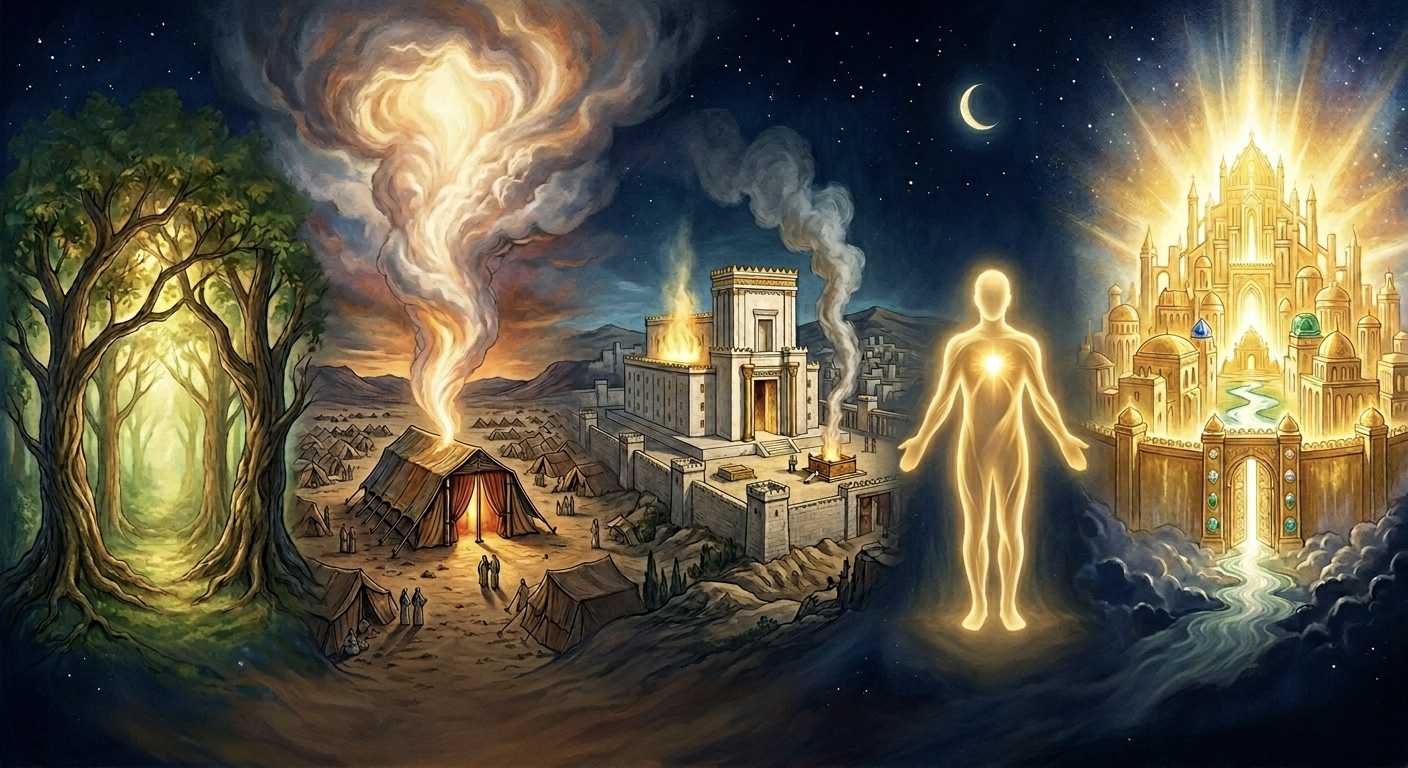
You may have heard His name a thousand times. In church. In a song. Spoken over you in prayer. But hearing a name is not the same as knowing a Person.
He is not a force you channel. He is not a feeling you chase. He is not the electricity in the room when the worship gets loud. He is a Person. And He was present before anything existed to witness Him.
The Hebrew word is merachefet. It appears only twice in all of scripture — here, and in Deuteronomy 32, where Moses describes an eagle hovering over her young. Protective. Attentive. Present over what has not yet become what it will be.
Before Abraham. Before Israel. Before the law, the temple, the church, the cross — the Spirit was already there, hovering over the dark, waiting to bring forth life. That is where this story begins. Not with a patriarch. Not with a promise. With a Person.
Hevel — the Hebrew name Eve gave Abel, the first righteous man on earth — means breath. Vapor. Mist. The same word Ecclesiastes uses thirty-eight times for everything that passes. The first righteous life on earth was named Breath, and his brother killed him. The breath ended. And the Spirit — the breath of God — kept hovering over what humanity had broken. He has been hovering ever since. There is a life you were made for that you are only ABLE to live by leaning on Him. Not your strength. His. The name and the word are the same — to be able is to be like Abel: dependent on breath that is not your own.
The Holy Spirit is not a doctrine to debate or a feeling you chase at a revival meeting. He is the third person of the Trinity — co-equal, co-eternal, fully God — and he has been the active agent of every miracle, every prophecy, every impossible birth, every burning bush, every road-to-Damascus moment in this entire story.
When scripture says God spoke — the Spirit carried the word. 2 Pet 1:21 When prophets saw visions — the Spirit opened the eyes. When the dry bones rattled in Ezekiel's valley — the Spirit breathed. When Mary conceived — the Spirit overshadowed. When Jesus was baptized — the Spirit descended. When the disciples preached in languages they had never learned — the Spirit spoke through them.
He is the agent. Every time. Without exception.
You can trace the genealogy, map the geography, memorize the facts — and miss the whole thing. Why God chose this man, why Hagar was found in the desert, why Philip ran to a chariot, why people in Iran are dreaming of Jesus tonight — none of it reads as anything but coincidence until you see the Spirit as the living protagonist moving through all of it.
The Spirit didn't arrive at Pentecost. Pentecost changed where he lived — from upon to within. But he was always present. Always moving. Always carrying the covenant forward.
Every one of these moments carries the same signature. An impossible situation. A person who could not do what needed to be done in their own strength. And the Spirit — moving. Equipping. Speaking. Providing what was humanly unavailable.
That has always been the pattern. It still is.
In the Old Testament, the Spirit came upon people. Selectively. Temporarily. For a task. He rested on the judges when battle required it. He came upon Saul when he was made king — and departed when Saul's heart turned. He filled Bezalel to build the tabernacle, then the work was done. He could be asked for, sought, grieved away. He was never guaranteed.
David knew this firsthand. After his worst sin, his deepest prayer was not for forgiveness alone but for presence: "Do not cast me from your presence or take your Holy Spirit from me." Psalm 51:11 He had watched the Spirit leave Saul. He knew it could happen to him.
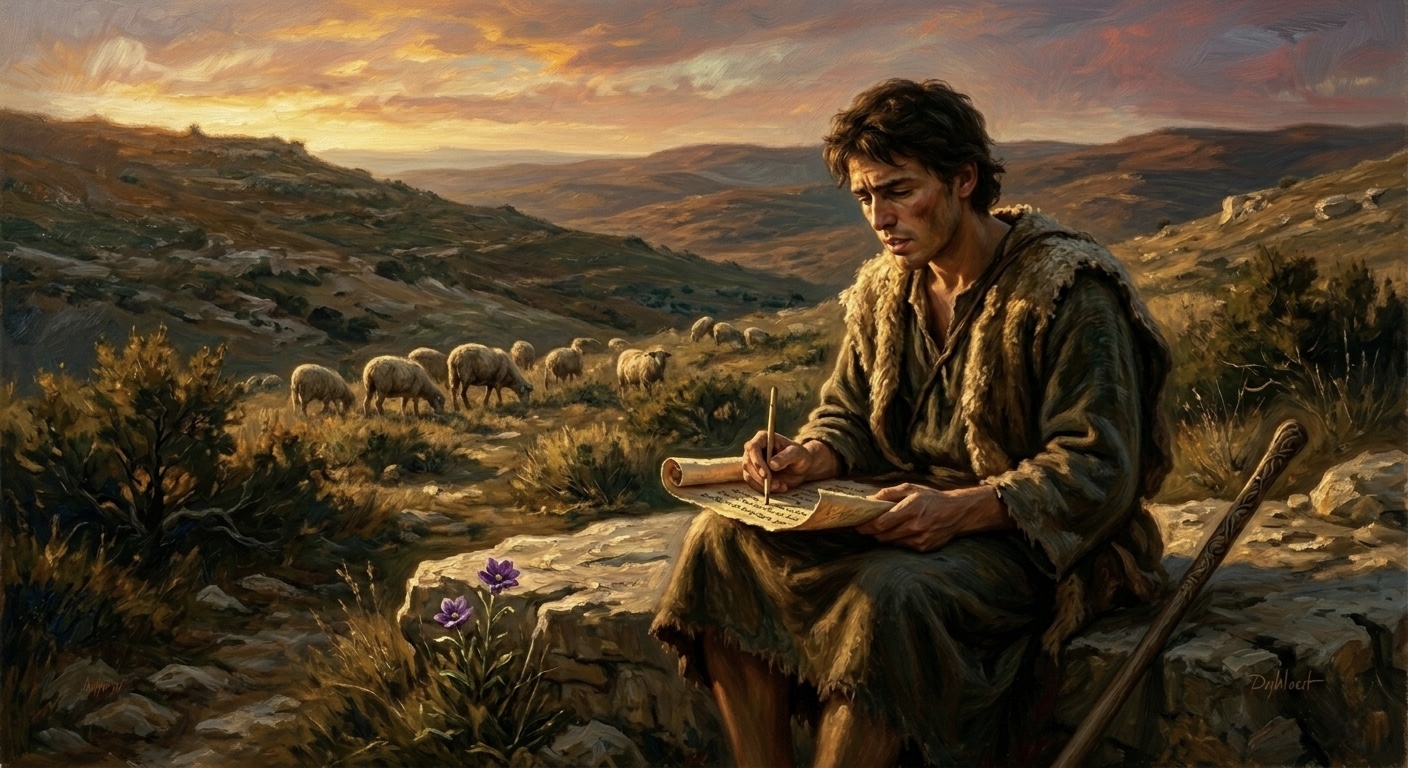
And then Jesus said something that changed everything.
Forever. Not for a task. Not for a season. Forever. And not just with you — in you. The distinction Ezekiel had prophesied. The shift from upon to within. The God who created the universe choosing to make his permanent dwelling not in a temple of stone but inside the people who love him.
Every other faith in the world places God above, beyond, outside — requiring you to reach up, journey toward, perform enough to approach. Jesus said: he is coming to live inside you. Permanently. Starting soon. Not a temple. Not a mountain. You. That is the whole new covenant in one word.
Jesus died. Rose. Appeared to 500 people over 40 days. 1 Cor 15:6 And then — before he ascended — he told the people who had believed in him, walked with him, died for him, and seen him resurrected — to stop. Wait. Don't move yet.
These were not new converts. They had seen every miracle, heard every sermon, watched the crucifixion, touched the resurrection wounds. And Jesus told them it wasn't enough. Not without the power.
The Greek word for power is dunamis. It is the root of the English word dynamite. Not persuasion. Not good theology. Not organizational skill. Dunamis. Supernatural enabling. The kind of power that makes a fisherman stand in front of thousands and turn them inside out with a single speech. The kind of power that makes a persecutor of Christians become the greatest missionary in history the moment a light knocks him off his horse.
Without it, they were just people with a story. With it — they were witnesses to the ends of the earth.
"They all joined together constantly in prayer." Acts 1:14
"When the day of Pentecost came, they were all together in one place." Acts 2:1
Together. United. One accord. Not in perfect theological agreement — these were people who had been arguing about who was greatest in the kingdom weeks earlier. Luke 22:24 But they had stayed. They had chosen each other over their disagreements. And in the choosing — the fire fell.
Jesus had prayed for exactly this, the night before he died: "That all of them may be one, Father, just as you are in me and I am in you — so that the world may believe that you have sent me." John 17:21
Unity is the condition. Not uniformity — they didn't all think the same. Not hierarchy — no one was in charge of the Spirit. Unity. The decision to stay together, stay in prayer, stay in the room — until the promise came.
This is not ancient history. Every denomination that has split, every congregation that has fractured over worship style or politics or personality — is a closed door. The same Spirit who fell when 120 stayed together is still looking for people willing to stay together long enough for the fire to fall again.
And if you want what fell in that upper room — Jesus said it simply: "How much more will your Father in heaven give the Holy Spirit to those who ask him." Luke 11:13 You can ask. Right now. That's all.
He has been waiting for you to ask. That was always the only thing he wanted.
Genesis 11 ends with a scattering. The entire human race — one language, one community, one place — divided and dispersed at Babel. What had been unified was broken into pieces. What could communicate fell silent across its own divisions. Gen 11:1-9
Genesis 12 opens with God calling one man.
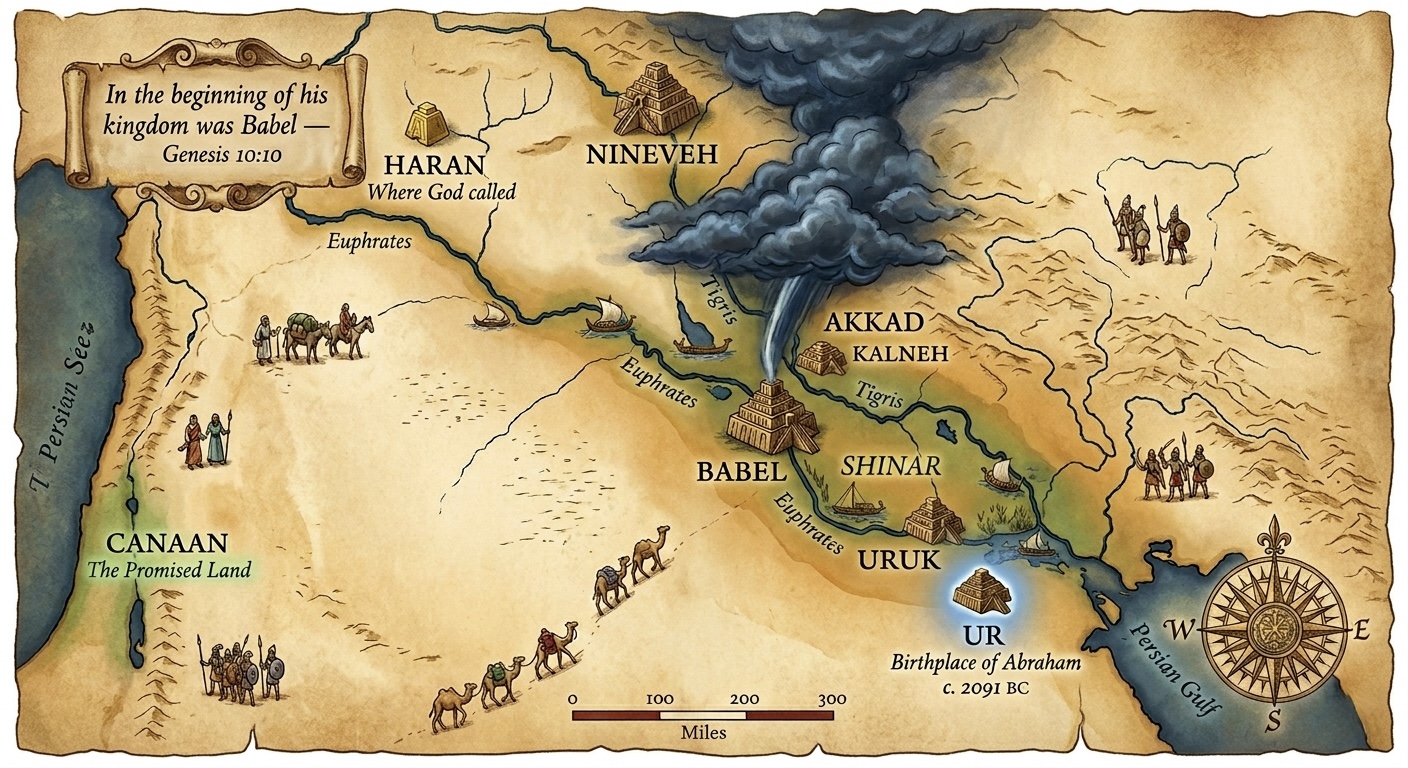
The call of Abraham is God's direct response to the wound of Babel — not a unilateral repair from the top down, but a seed planted in a single man's obedience that would, over millennia, regather every nation that had been scattered. "All peoples on earth will be blessed through you." Gen 12:3 Every people. The ones scattered at Babel. The ones divided by language and culture and geography. Through one man's faith — brought back.
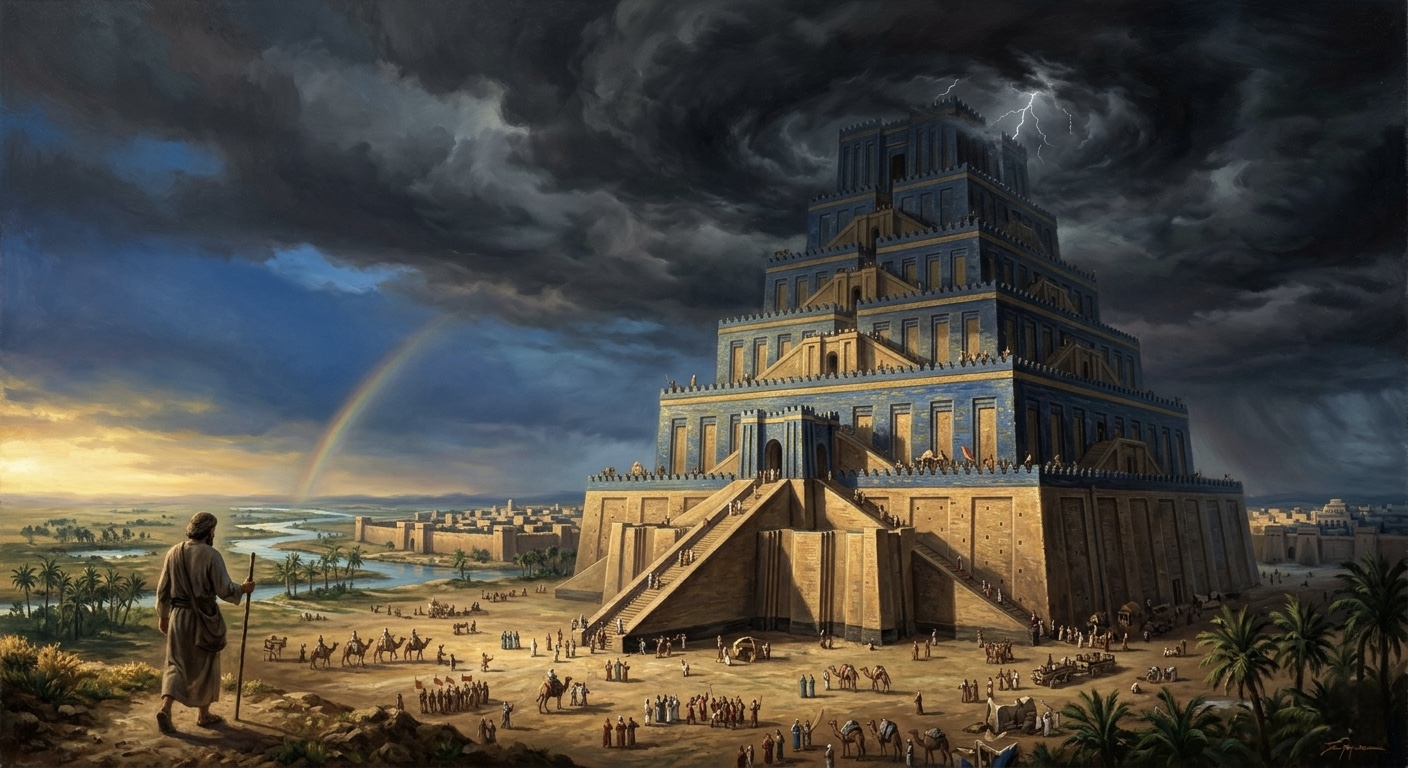
Etemenanki — Sumerian for "House of the Foundation of Heaven and Earth." A massive stepped ziggurat on the site of ancient Babylon, in what is now central Iraq. The site's origins reach back to at least the Old Babylonian period, c. 2000–1800 BC — the world of Abraham. The same city. The same ambition. The same site Genesis 11 describes.
Fifteen centuries later, Neo-Babylonian king Nabopolassar began its monumental rebuilding, and his son Nebuchadnezzar II — the same king who destroyed Jerusalem and carried Israel into exile — completed it. Nebuchadnezzar's own clay cylinder inscription, excavated from Babylon, reads: "I raised the top of Etemenanki so that it rivaled heaven." The man who burned the temple of God in Jerusalem was simultaneously completing the tower that represented everything Genesis 11 condemned. The two buildings — God's dwelling place and man's counterfeit — existed at the same historical moment, in direct confrontation.
The Greek historian Herodotus, visiting Babylon c. 450 BC, described the tower in detail: a series of eight platforms rising to a great temple at the top, estimated at 300 feet tall, with an external staircase spiraling to the summit. He was describing the structure Nebuchadnezzar finished. The ruins still stand at the site of Hillah, Iraq, identifiable today by satellite imagery.
The tower wasn't a one-time act of pride. It was a recurring one. Nimrod started it. Nebuchadnezzar perfected it. Babylon kept rebuilding the same statement across 1,500 years — and God kept answering it with the same counter-move: not a bigger tower, but a humbler man.
God's answer was not a counter-empire. It was one man. The tenth descendant from Noah — selected at the precise generation God ordained, not the ninth, not the eleventh. Abraham was not random. He was the kingdom answer to the kingdom problem.
The rabbinical tradition preserved in Pirkei Avot 5:3 records that Abraham was tested ten times — and passed every one. God does not hand his purposes to an unproven man. Ten trials forged the vessel the promise required. Moriah was the tenth. There the illusion broke. What looked like a father walking his son up a hill to die was, in a single irreversible instant, pulled back to show what it had always been — God swearing by himself, because there was no one greater to swear by. A kingdom oath. Sworn at the point of no return. On a mountain that would one day be Calvary.
| NIMROD'S KINGDOM
Babel — man reaching up to God Built by pride and rebellion First kingdom — Genesis 10:10 Scattered at Babel Counterfeit throne |
GOD'S KINGDOM
Moriah — God coming down to man Built through surrender and faith True kingdom launched — Genesis 12 Gathered through Abraham's seed Eternal throne |
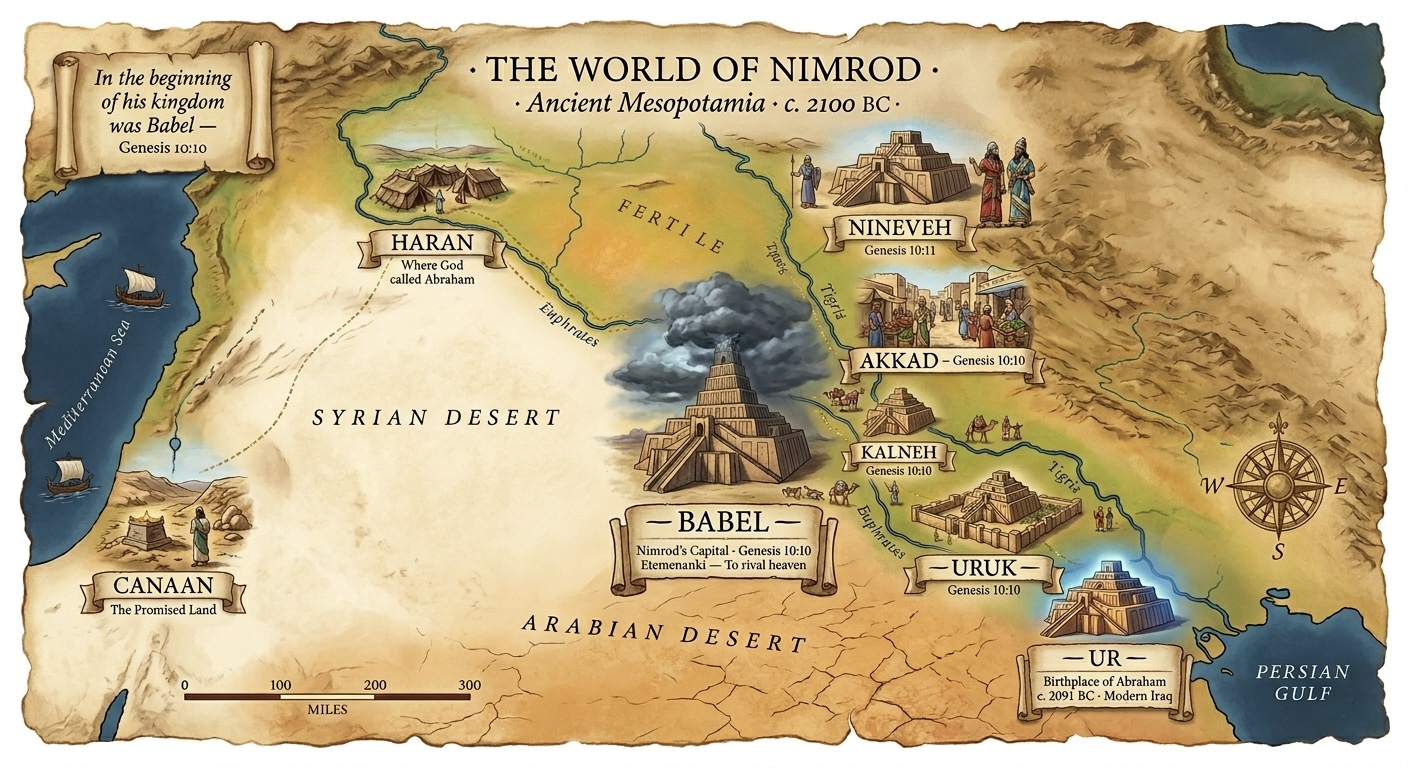
The city of Ur sat on the banks of the Euphrates in what is now southern Iraq — around 2000 BC one of the most sophisticated cities on earth. Massive ziggurat temples. A thriving economy. A literate class. And a marketplace full of gods carved from wood and stone, sold by a man named Terah to a city that believed them. Joshua 24:2
Terah's son Abram grew up in the shop. He knew every idol by name, knew what each one was supposed to do, knew the prayers and the rituals and the offerings. And somewhere in his childhood or his youth, he started watching the sky instead.
The Book of Jubilees — found among the Dead Sea Scrolls, used as scripture by the Ethiopian Orthodox Church, cited with authority in ancient Jewish tradition — preserves what the rabbis remembered about that watching. Jubilees 12:1-8 Young Abram looked at the sun and reasoned: something made that. He looked at the moon and the stars: something made those too. And whatever made all of this cannot be made of wood. He worked his way through every created thing — fire, water, clouds, wind — and arrived at the uncreated Creator by logic. Not by revelation. Not yet. By paying attention to what was in front of him and following the reasoning wherever it went.
One night he burned his father's idol house to the ground.
Not out of rebellion. Not out of anger. Out of the same conviction Paul would later articulate in Romans 1:20 — that the invisible qualities of God are clearly seen through what he has made, so that people are without excuse. Abram had seen them. He couldn't unsee them. The idols were not merely wrong theology — they were an insult to the God who had made the sun and the moon and the stars and was being represented by something a craftsman had shaped with his hands.
He was seventeen years old, according to some traditions. He had no community of faith. No scripture. No priest. No tradition. Just eyes that had been watching the sky and a mind that had followed the evidence to its logical conclusion — there is a God, and none of these are him.
He found God by paying attention to a sky everyone else slept under. The seeking was never the hard part. The looking up was.
Abram was seventy-five when God spoke in Haran — halfway between Ur and Canaan, where his father Terah had stopped, settled, and died. Gen 12:4 Thirty years of seeking. Then — a voice.
No map. No destination. Just — go. To a land I will show you. Present tense. As you travel. One step at a time.

Hebrews 11:8 says he left "not knowing where he was going." That is what faith actually is — not certainty, not a feeling. He was seventy-five. His wife was barren. He was leaving everyone he knew. Faith is movement toward a voice you trust before the destination exists.
Not one family. Not one nation. All peoples on earth. Paul identifies this moment explicitly as the gospel preached in advance: "Scripture foresaw that God would justify the Gentiles by faith, and announced the gospel in advance to Abraham: All nations will be blessed through you." Gal 3:8
The gospel was not invented at Calvary. It was not launched at Pentecost. It was announced in Haran to a seventy-five-year-old man with a barren wife and no children, as the reason to pack his bags. Everything since has been the delivery of what was promised that morning.
Years passed. Abram reached Canaan, survived a famine in Egypt, parted from Lot, fought a war to rescue him — and on the way back was blessed by Melchizedek, a priest-king with no genealogy, no beginning and no end in the text, serving bread and wine in the name of God Most High, Creator of heaven and earth. Gen 14:18-20 Christ himself would later be called a priest in this order — not Aaron's, not the Levites' — because the priesthood was universal before Israel existed, and would be again. Remember that priest-king. He returns at the end of this story. Heb 7:17
And still — no child.
God spoke again and Abram answered honestly: "What can you give me since I remain childless?" Gen 15:2 Not faithless — honest. The man who had walked from Haran on a word was now naming the gap between the promise and the reality, out loud, to God's face. And God did not rebuke him. He took him outside.
"Look up at the sky and count the stars — if indeed you can count them. So shall your offspring be." Gen 15:5
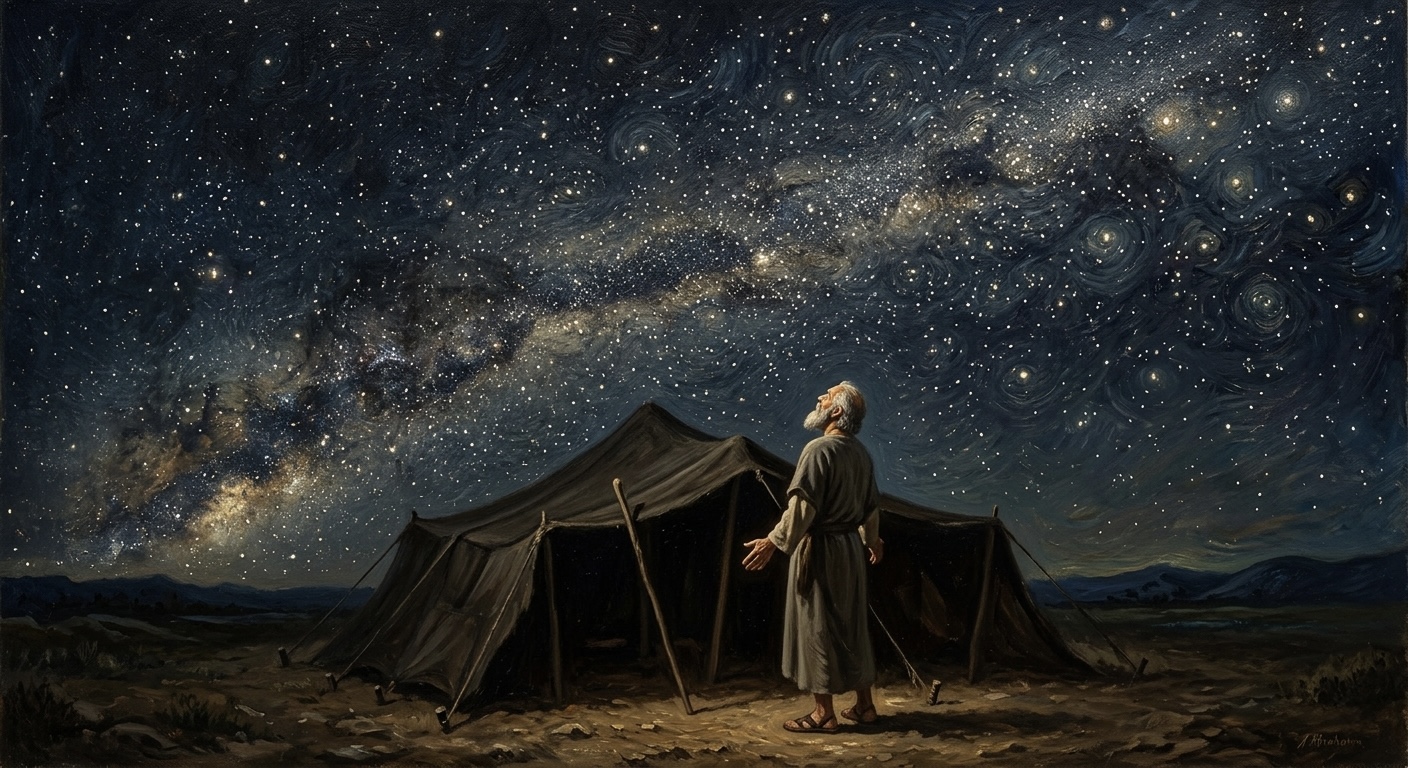
And Abram believed. That single sentence — "Abram believed God, and it was credited to him as righteousness" Gen 15:6 — is the verse Paul builds his entire theology of grace upon in Romans 4. A man got declared right with God for trusting him — before circumcision, before the law, before a single rule existed to keep or break. No performance. No religious system. He looked up at stars he couldn't count and decided the voice was telling the truth. God called that righteousness.
One old man. A barren wife. The smallest of all nations — before a nation even existed. God did not choose Abraham because he was impressive. He chose him because He loved him and because He had decided to keep His word. That is the only explanation the Bible offers. Not merit. Not size. Not performance. Love and faithfulness. The same reason He is still choosing you.
Then came the ceremony. God told Abram to cut animals in half and lay them in two rows. Gen 15:9-10 Every ancient Near Eastern reader would have recognized what this meant — the covenant ritual, where both parties walk between the pieces and say in effect: may what happened to these animals happen to me if I break this promise. Abram prepared everything. Split the heifer, the goat, the ram. Laid the dove and the pigeon. Drove away the birds of prey that descended on the carcasses. And waited.
As the sun was setting, a deep sleep fell on him. A thick and dreadful darkness. Gen 15:12 And then — only God moved. A smoking firepot and a blazing torch — the presence of God — passed between the pieces alone. Gen 15:17
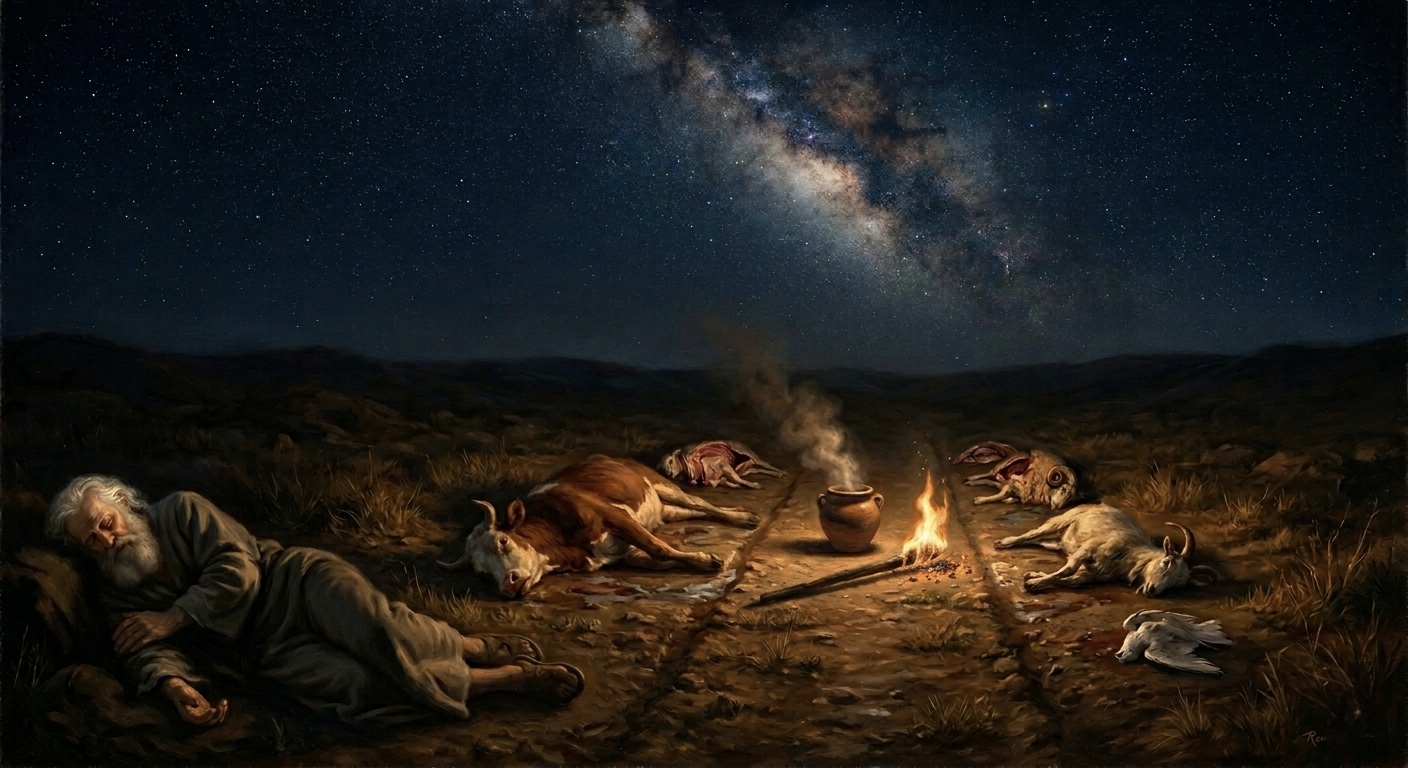
Abram never walked through. Only God moved. In the one ceremony where Abram should have sworn let me die if I break this — God put himself under the knife instead. He swore to die before he would let the promise fail.
The Hebrew word woven through every covenant promise from this moment forward is hesed — translated variously as lovingkindness, steadfast love, mercy, loyalty. But no single English word holds it. Hesed is the love that does not leave when it has every right to. It is covenant loyalty that outlasts the failure of the other party. It is what God showed Abraham at this ceremony — binding himself to keep a promise to a man who would fail him repeatedly — and it is what runs like a thread through every page of this story. David sang it. Jeremiah wept it. Ruth embodied it toward Naomi. The entire Abrahamic covenant is built on it. Hesed. The love that does not count exits.
This is the foundation of everything that follows. God bound only himself. The covenant's validity depends entirely on God's faithfulness — not Abraham's, not Israel's, not the church's, not yours. The fractures, the failures, the schisms, the darkest moments in your own story — none of it touches what was signed alone by the smoking firepot in Canaan. The covenant is only as breakable as God is breakable.
Which is to say: it is unbreakable.
Whatever you have done. Whatever has been done to you. The smoking firepot moved. The promise stands.
But understand this clearly: the covenant was never designed to leave you where it found you. The same God who signed it alone is the God who sends His Spirit to transform from the inside. The promise does not excuse — it empowers. Grace is not permission to stay broken. It is the power to become whole. The covenant holds you so that you can be changed — not so that change doesn't matter.
In 1974, excavators at Tell Mardikh in northern Syria unearthed the royal archives of ancient Ebla — 15,000 clay tablets dated to 2400 BC. Among them: a geographic atlas listing the five cities of the plain by name — Sodom, Gomorrah, Admah, Zeboiim, Zoar. These cities appear together in only one chapter of the Bible: Genesis 14. Long dismissed as legendary, they were real enough to appear in a Syrian trade archive a thousand years before Moses wrote them down. Paolo Matthiae, University of Rome, excavation reports 1975–1976.
The Nuzi Tablets — 5,000 cuneiform documents excavated from northern Iraq, 1925–1931 — independently confirm that the surrogate wife arrangement Sarah proposed to Abraham was standard Bronze Age legal contract, not desperation. The tablets document identical arrangements: a barren wife was legally required to provide her husband a slave woman as surrogate, with any child legally belonging to the wife. Genesis wasn't recording a scandal. It was recording a real legal world, with precision. American Schools of Oriental Research, excavation reports 1925–1931.
God gave Abraham the promise in two images — and they may not be pointing at the same thing.
Genesis 15:5 — at night, looking up: "Count the stars — so shall your offspring be." Stars. Heavenly. Uncountable only because of distance. You are looking up to find them.
Genesis 22:17 — after Moriah, after the knife was raised and the ram was provided: "I will make your descendants as numerous as the stars in the sky and as the sand on the seashore." Both. Stars and sand. Heavenly and earthly. Spiritual and physical.
Bible teachers including Derek Prince have taught this dual image as two tracks running simultaneously through the whole covenant story: a physical track — Israel, the Arab nations, the biological descendants — and a spiritual track — everyone who believes as Abraham believed, from every nation, in every generation. Paul confirms: "He is the father of us all." Rom 4:16 Not just the Jews. Not just the church. The father of everyone who has ever looked at the stars and decided to trust the voice they could not quite explain.
When you stand before the throne in Revelation 7:9 — every nation, tribe, people, and language — you are one of those stars. You were in this promise the night Abraham stood in Canaan and couldn't count them. Before your parents met. Before your name existed. You were already counted.
Enoch — walked with God so closely that death was not required of him. The earliest picture of what a Spirit-filled life produces. By faith.
Noah — warned about things not yet seen. Built an ark on dry land. By faith.
Abraham — left, not knowing where he was going. Believed the stars. Raised the knife. Reasoned resurrection on the road. By faith.
Sarah — received strength to conceive past all biological possibility. By faith — judging him faithful who had promised.
And then the writer says something that should change how you understand your place in this story:
"These were all commended for their faith, yet none of them received what had been promised — since God had planned something better for us, so that only together with us would they be made perfect." Heb 11:39-40
The Hall of Fame is not closed. It was never meant to be a museum. You are in this story — and Abraham's faith is not complete without yours.
A year passed. Then five. Then ten. The stars Abraham had counted that night in Canaan still hung in the sky — but the tent was empty. Sarai was still barren. The promise had not arrived. And the man who had walked away from everything he knew on a single word from God began to wonder if God needed a little help.
He had already failed in the exact place God was asking him to trust. Twice he had handed Sarai to other men to save his own skin — once to Pharaoh in Egypt, once to Abimelech in Gerar. Gen 12; 20 Each time God rescued her. Each time Abraham walked away richer than he arrived, with a wife he had been willing to lose. The covenant was not carried by a hero. It was carried by a man who, in his fear, had thrown away the very person the promise was supposed to come through — and God had given her back to him both times anyway.
First: Egypt. Afraid Pharaoh would kill him for Sarai, Abraham told her to say she was his sister. He handed her over. The covenant heir had not yet been born — and Abraham gave away the woman through whom the promise would come. God sent plagues on Pharaoh's house and forced her return. Gen 12:17-19
Second: Gerar. Abraham did it again — same lie, same fear, same woman. This time to Abimelech. God appeared to Abimelech in a dream before he touched her: "You are as good as dead because of the woman you have taken — she is a married woman." She was returned. Gen 20:3
Third: Hagar and Ishmael. Abraham had brought a second woman into the covenant household through unbelief — then sent her and his firstborn son into the desert with a single skin of water when Sarah demanded it. A third time, the consequences of Abraham's choices threatened everything. A third time, God stepped into the desert and secured what Abraham's fear had endangered.
The covenant did not survive because Abraham protected it. It survived because God refused to let it fail — even when the man carrying it kept setting it down. This is not a footnote. It is the whole point. God did not choose a perfect vessel. He chose a real man — and kept His word in spite of him, through him, and ultimately for him. The same Spirit who retrieved the promise from Pharaoh's palace and a desert bush will retrieve what fear has cost you.
Sarai had an Egyptian servant named Hagar — likely acquired years earlier during the disastrous detour through Egypt when Abraham, afraid for his life, had told Pharaoh she was his sister. Gen 12:15-16 Now Sarai came to her husband with a plan that was entirely legal, culturally accepted, and practically reasonable: give Hagar to Abraham as a secondary wife. Any child born would legally be Sarai's. The covenant heir would exist. The promise would be fulfilled.
It was the most sophisticated act of unbelief in the Bible — not a crude rejection of God, but a careful, culturally competent attempt to accomplish what God promised by means God never prescribed. The Nuzi tablets — 5,000 cuneiform documents from northern Iraq — document this exact arrangement as standard Bronze Age legal practice: a barren wife was legally permitted to provide her husband a surrogate, with any child belonging legally to the wife. What Sarai proposed wasn't scandalous. It was the reasonable thing to do.
God had not called Abraham to reasonable solutions. He had called him to impossible faith — faith in a God who specializes in the biologically impossible, who signed the covenant alone so that human failure and human cleverness alike could never claim credit for the outcome. The moment Abraham and Sarai reached for what was possible, they stepped outside the promise.
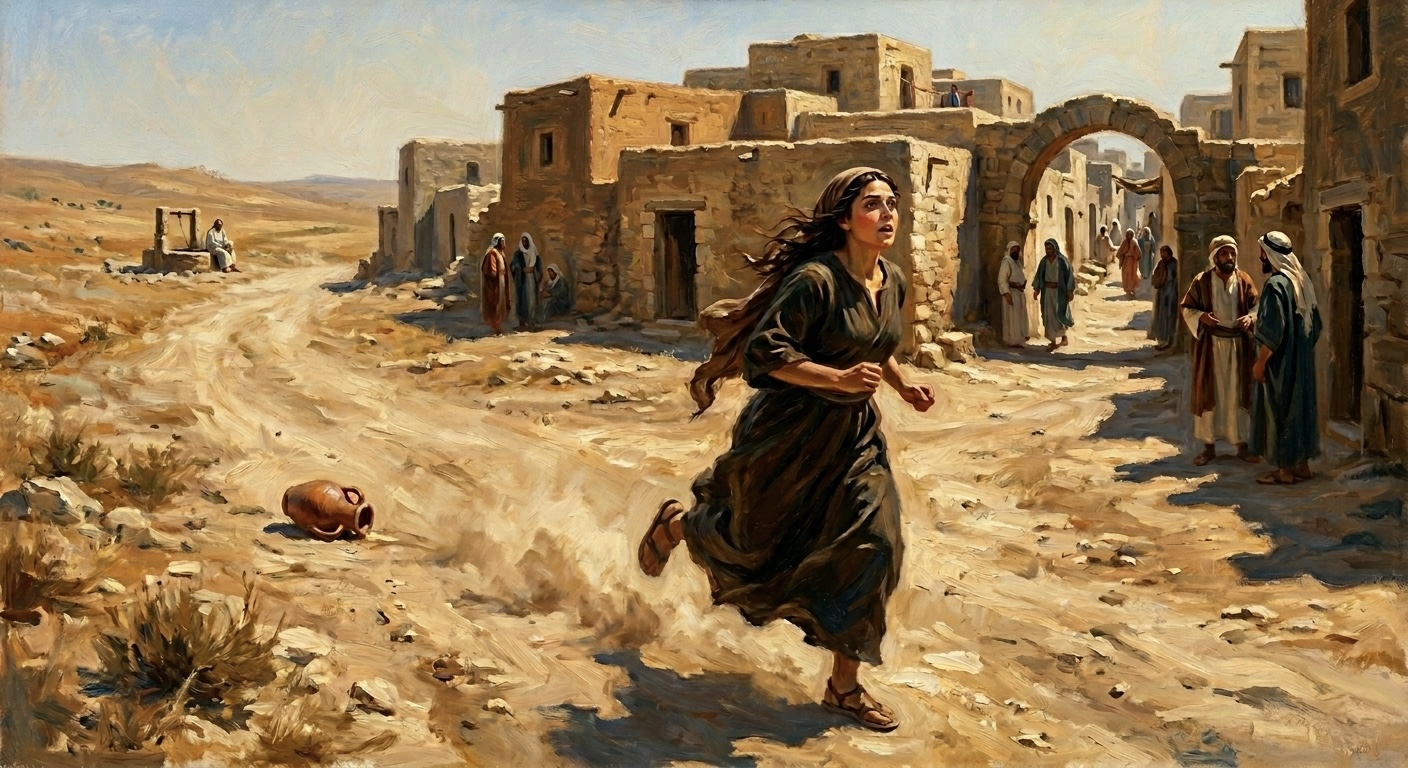
Hagar conceived. The moment she did, something shifted between the two women — as it always does when status changes inside a house. Hagar looked at Sarai differently. Sarai felt it, and answered with cruelty. The wound was real: the covenant family turning on the very outsider God was about to honor. And Hagar — pregnant, alone, foreign, legally a possession with no recourse — did the only thing she could do.
She ran.
She ran into the desert. Toward Egypt, the scripture implies — toward home, toward something familiar, toward anything that wasn't this tent and this woman and this child growing inside her that had become the source of her suffering instead of her salvation. Gen 16:6-7
An angel found her at a spring on the way to Shur. The desert. Alone. Pregnant. No water, no shelter, no protection, no legal standing, no one in the world who would have noticed if she simply disappeared.
The angel spoke to her by name.
"Hagar, servant of Sarai — where have you come from, and where are you going?" Gen 16:8
He already knew the answers. He asked anyway — not for information. To address her. By name. Treating her as a person with a story that mattered, not as a servant whose movements required no explanation.
Then he made her a promise that sounds almost identical to the one he had made to Abraham:
"I will increase your descendants so much that they will be too numerous to count." Gen 16:10
The same language. Too numerous to count. Stars you cannot count. What began as a human workaround — Sarai's plan, not God's — God took and elevated into something real. He did not endorse what Abraham and Sarai had done. But He refused to let the child produced by their fear become merely a footnote. He found Hagar in the desert before the child was born and spoke covenant language over a son who had not yet drawn breath. This was not God approving the detour. This was God refusing to abandon the people the detour created.
"You are now pregnant and you will give birth to a son. You shall name him Ishmael — God hears — because the LORD has heard of your misery." Gen 16:11
And then Hagar did something no one else in the entire Bible does.
She named God.
Not Abraham. Not Sarah. Not Moses. Not any of the patriarchs whose names fill page after page of the covenant story. An Egyptian slave woman — the lowest person in the household, legally a possession, carrying a child she had not chosen to carry for a man she had not chosen to serve — looked up from a desert spring and gave the living God a name.
El Roi. The God who sees me.
She had not prayed. She had not fasted. She had performed no religious act at all. She had simply been seen — truly seen, by someone who knew exactly where she had come from and exactly where she was going — and the only response she had left was to give him a name for what he had done.
God heard the misery of a slave woman. He has not stopped hearing.
A slave nobody counted gave God a name. What makes you think you're the one He overlooks?
Written seven centuries after Hagar — but describing the same God. The one who finds people in deserts. Who opens water where there is none. Who makes roads through wilderness for people who have no reason to expect a road. Hagar's spring on the road to Shur was not an anomaly. It was an introduction.
Hagar returned. Ishmael was born. Abraham held his firstborn son — the son he had waited for, the son he had loved before he existed — and named him exactly as the angel had instructed. God hears.
For thirteen years, Ishmael was everything. The heir. The proof that Abraham's line would continue. The boy who rode with his father, who learned from him, who was circumcised at thirteen with the covenant sign — old enough to understand what he was receiving, old enough to have made his own choice about it. Gen 17:25
Then God appeared to Abraham again and told him that the covenant heir — the one through whom the promise would flow — would be a son born to Sarah. Not Ishmael.
Abraham's response tells you everything about who he had become:
Not — why not Ishmael? Not — after everything I've done, after the waiting, after the covenant ceremony, after following you from Ur to Canaan, is this really necessary? Just — please, let him be blessed. A father's prayer for the son he loves, offered at the exact moment he learns that son will not be the one he hoped.
God answered the prayer. Every word of it. "As for Ishmael, I have heard you. I will surely bless him — I will make him fruitful and greatly increase his numbers. He will be the father of twelve rulers, and I will make him into a great nation." Gen 17:20 The word is barak — the covenant word, the blessing word, the same word that runs like a thread through every promise God has ever made in this story. Ishmael received it. And the invitation Paul would later make explicit was already true here: "everyone who calls on the name of the Lord will be saved." Rom 10:13 The covenant ran through Isaac — but the door would open for the whole family.
The covenant would pass through Isaac. But Ishmael was never abandoned. That distinction matters enormously — it is the theological key to understanding Islam, to understanding the hostility and the longing and the 1.8 billion people who call Abraham their father and mean it — and it will matter again at the end of this story in ways that Isaiah could see and we are only beginning to see.
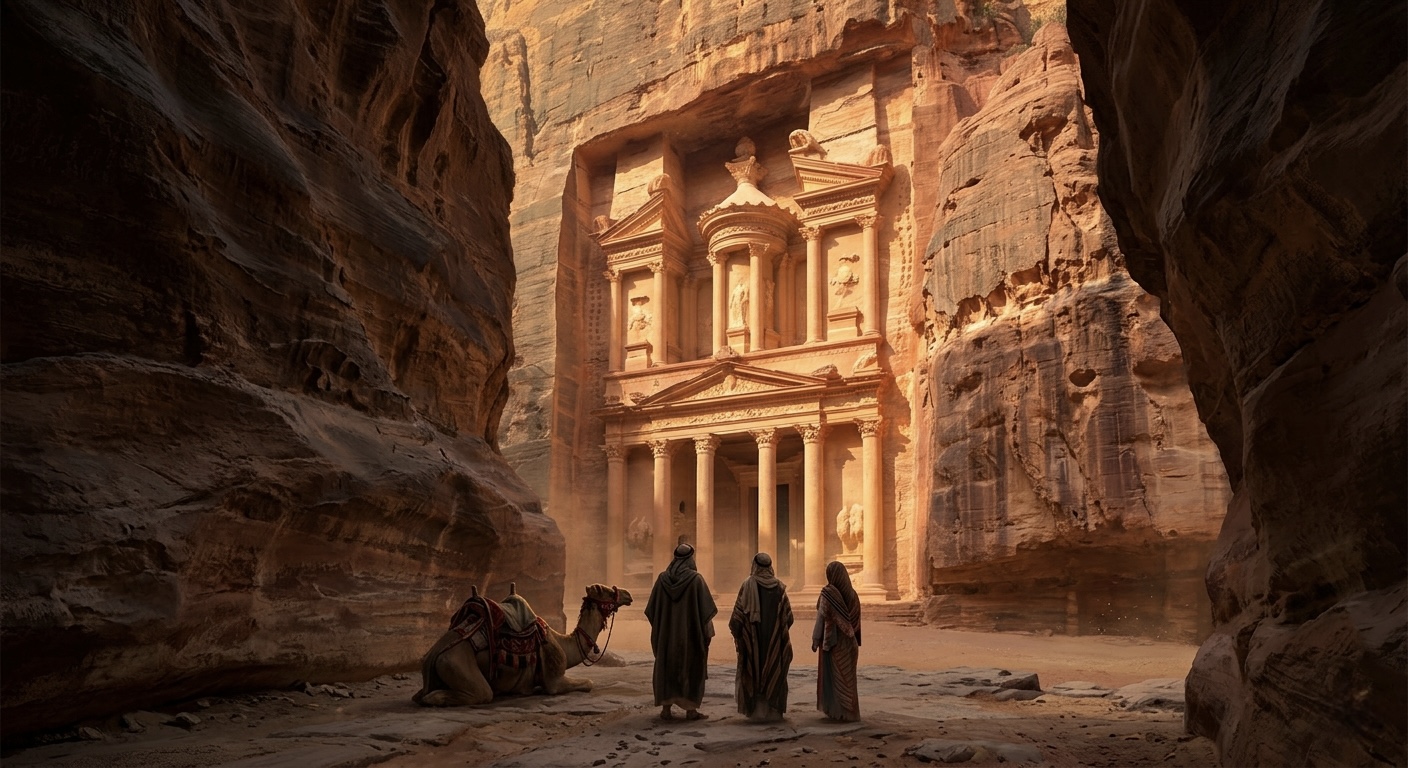
Josephus — writing in the first century from Jerusalem, obtaining his information directly from Arab contemporaries — identified the Nabataean Kingdom as the descendants of Ishmael's firstborn son Nebaioth, and said they "occupied the whole country from the Euphrates to the Red Sea." Josephus, Ant. 1.12.4 Their capital was Petra — a city carved into red rock in what is now Jordan, one of the architectural wonders of the ancient world, a trading empire that connected Rome to India and resisted Roman conquest for four centuries. God promised Ishmael would become a great nation. Petra is that promise carved in stone.
Isaac was born. Sarah's laughter — the laughter she had hidden when the angels told her, the laughter God had called her on Gen 18:15 — became real. The impossible had happened. And Sarah, holding her son, looked at Ishmael differently than she ever had before.
At Isaac's weaning feast she saw Ishmael mocking her son — the Hebrew word metzachek is related to Isaac's own name, a bitter wordplay — and something broke in her. She went to Abraham: "Get rid of that slave woman and her son, for that woman's son will never share in the inheritance with my son Isaac." Gen 21:10
The text says Abraham was greatly distressed. Gen 21:11 Two words in the English. In the Hebrew it is the word for evil — ra — something against the nature of things. Obeying God meant doing the thing that felt wrong in his bones. This was his son. His firstborn. The boy he had named and circumcised and loved for thirteen years — and God was telling him to send him into the desert.
God told him to listen to Sarah. He sent Hagar and Ishmael into the desert of Beersheba with bread and a single skin of water. Gen 21:14
A skin of water. For a woman and a teenage boy. In the desert.
The water ran out. Hagar did what a mother does when she has nothing left to give — she put Ishmael under a bush, in whatever shade the desert offered, and walked away. About a bowshot's distance. Just far enough that she would not have to watch him die.
She sat down and wept.
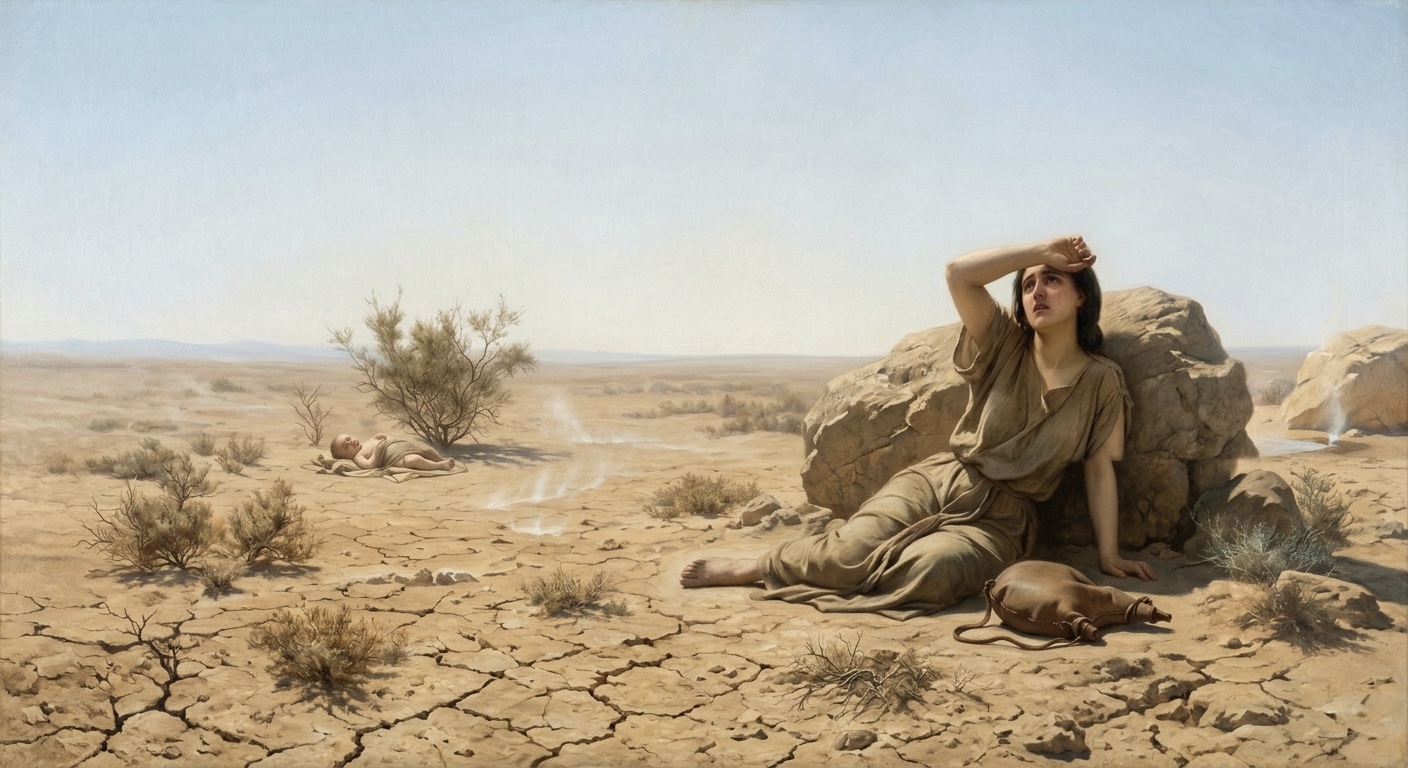
And then — the most quietly devastating verse in the story of Ishmael:
Not Hagar. The text says she wept — but God heard the boy. The boy who was silent to his mother. The boy lying under a bush in the Beersheba desert with no water and no hope, whose mother had walked away because she could not watch. That boy made a sound — not a sound anyone around him could hear, not a sound the text tells us was audible — and God heard it.
The angel of God called to Hagar from heaven: "What is the matter, Hagar? Do not be afraid — God has heard the boy crying as he lies there." Gen 21:17 Then: "Lift the boy up and take him by the hand."
God opened her eyes. She saw a well of water. She filled the skin. She gave the boy a drink.
"God was with the boy as he grew up." Gen 21:20
Five words. The entire inheritance of Ishmael contained in five words. Not the covenant. Not the temple. Not the promise through which the Messiah would come. But — God was with the boy. El Roi, the God who had seen Hagar at the desert spring, was with her son in the wilderness. And he never stopped being with him.
His mother walked away so she wouldn't have to watch. God walked toward the sound she couldn't hear.
Four thousand years later, 2-3 million Muslims performing Hajj walk between the hills of Safa and Marwa to commemorate this — a mother and a dying child in the desert, and water where there was none. The ritual is called Sa'i — the running — and it re-enacts Hagar's desperate search for life in the wilderness. The Zamzam well still flows beneath the Grand Mosque in Mecca, producing thousands of liters an hour — the water God opened for a desperate woman in the desert, still running in the holiest site in Islam.
Hagar was the first woman to carry the promise — slave, foreigner, chosen at a desert spring. She was not the last. The covenant story is told through the names of men, but at every hinge moment, when it was about to slip away, a woman caught it.
Rebekah heard God speak before she married Isaac, before she had children. "Two nations are in your womb," God told her. "The older will serve the younger." Gen 25:23 Years later, when Isaac lay dying and prepared to give his blessing to the wrong son — the son who had despised his birthright, who had married Canaanite women who were a grief to his parents Gen 26:35 — Rebekah acted. She devised the disguise. She prepared the food. She dressed Jacob in goatskins. And when Jacob said what if my father discovers the deception and curses me? she answered: "Let the curse fall on me, my son." Gen 27:13 She paid everything to ensure the covenant landed where God had said it would land. She never saw Jacob again. He fled that night and she died before his return.
Tamar — Judah's twice-widowed daughter-in-law, denied what she was owed by law, left in slow destitution with no recourse. She took matters into her own hands in a way scripture does not soften. When Judah discovered it, he stopped cold: "She is more righteous than I." Gen 38:26 Matthew put her in the genealogy of Jesus by name. Matt 1:3 An act of desperation held the covenant line together.
Ruth was a Moabite — excluded by law to the tenth generation. Deut 23:3 Her husband dead. Every cultural expectation pointing home. Instead she said to Naomi: "Where you die I will die. Your God will be my God." Ruth 1:16 That declaration of covenant loyalty by a foreigner on a road in Moab became the great-grandmother of David. The covenant ran through her refusal to leave.
Mary of Nazareth was a teenager in a Roman-occupied village with no power, no status, and nothing to recommend her to history. When Gabriel appeared and told her what was about to happen to her body and her reputation and her life, she asked one practical question — how? — and then said: "I am the Lord's servant. May it be to me as you have said." Luke 1:38 A teenage girl from Nazareth understood exactly what was happening inside her — her Magnificat reaches all the way back to Abraham: "He has helped his servant Israel, remembering to be merciful to Abraham and his descendants forever, just as he promised our ancestors." Luke 1:54-55 She had been paying attention to the covenant her whole life.
And Mary Magdalene — in a culture where a woman's testimony was inadmissible in court, where female witnesses did not count — was chosen by God to be the first person to see the risen Christ. John 20:16 The first herald of the most important event in human history. Not Peter. Not John. Not any of the eleven who had followed Jesus for three years. A woman. The one the world would have dismissed. The one God trusted first.
Five women. Five different centuries. Five different forms of exclusion. Every one of them disqualified by someone. Not one of them disqualified by God. He has never once chosen the person the room would have voted for.
The rabbis say Abraham's greatest test was not Moriah. It was the twenty-five years before Moriah — the decades of waiting with an empty tent, the years of watching Sarai's face when she thought no one was looking, the slow erosion of a promise that hadn't arrived yet. The test of Moriah, they say, was only the final one. There had been nine before it.
But Moriah was the one that broke all categories.
Your son. Singular. As if Ishmael — the teenage boy Abraham had loved for thirteen years, wept over when God told him to send him away, the boy he had watched walk into the desert with a single skin of water — as if Ishmael no longer existed. Your only son. The one you waited a century for. Whom you love. God named the love out loud. Not because he didn't know. Because he wanted Abraham to feel the full weight of what was being asked.
And then — three words in Hebrew:
Vayashkem Avraham baboker. And Abraham rose early in the morning.
The root word is shakham — it means to load a burden onto the back of an animal before dawn. Not simply to wake early. To rise in the dark and begin bearing something heavy before the sun arrives. It is the word of someone who does not delay what they have decided to do. No second night of lying awake. No morning of reconsidering. In the darkness before dawn he saddled his donkey, split the wood, took his servants and his son — and set out. Three words in Hebrew carry the full weight of what twenty-five years of tested faith had produced: a man who had stopped arguing with God at dawn.
The man who had laughed when God said Sarah would conceive. The man who had tried to help God with Hagar. That man was gone. What remained was someone whose faith had been built through twenty-five years of impossible waiting into something unrecognizable — something that could move toward its own worst nightmare at dawn without hesitation, because it had learned that the God who asks can be trusted.
The region of Moriah was three days' walk from Beersheba.

Three days of walking — three sunrises, three nights of camp, three days of watching his son walk beside him. Isaac, whose name means laughter. Isaac, who was conceived when the body said impossible and God said watch me. Isaac, who was the only reason any of this had meant anything — the proof that the covenant was real, the living embodiment of thirty years of promise.
For three days Abraham walked with him. And said nothing.
What did he think? Hebrews tells us: "He reasoned that God could even raise the dead." Heb 11:19 Working through what he knew — the God who had given Isaac against all biology, who had bound himself in the covenant ceremony alone, who had promised that through Isaac his descendants would be counted — and arriving at a conclusion that would not be articulated clearly for another fifteen centuries: if God promised through Isaac, and God is asking for Isaac, then God must be planning to raise him from the dead.
Abraham reasoned his way to resurrection faith in the middle of the hardest three days he would ever walk. Not in a theological library. Not in a time of peace. On a road. Walking toward the thing he feared most. With his son beside him.
On the third day he saw the mountain. He turned to his servants and said: "Stay here with the donkey while I and the boy go over there. We will worship and then we will come back to you." Gen 22:5
We. Both of us. He did not know how. He simply believed that they would. He confessed resurrection before he climbed a single step of that mountain. Before the altar was built, before the wood was laid, before the knife was raised — Abraham was already speaking what he could not see. That is not wishful thinking. That is the prophetic gift operating under the most extreme conditions possible.
The three-day pattern is not incidental. It is God's recurring signature:
Genesis 22 — Isaac as good as dead from the moment God spoke, received back alive on the third day.
Jonah — three days in the fish. Jesus connects this explicitly to his own burial. Matthew 12:40.
Hosea 6:2 — "After two days he will revive us; on the third day he will restore us, that we may live in his presence." Written 700 BC.
Joseph — his brothers imprisoned three days before release. Genesis 42:17-18.
Every subsequent three-day resurrection pattern in the Old Testament is God repeating the word he first wrote on the road to Moriah. Abraham walked three days not knowing how the story ended. We read Genesis 22 knowing the ram is in the thicket. He didn't. His faith was not in an outcome he could see — it was in a God he knew. That is exactly the faith that justifies.
He gave Isaac the wood to carry. He kept the fire and the knife himself — the dangerous things, the things that could cut and burn. They walked up together.
Isaac asked the question that has haunted readers for four thousand years:
"Yes, my son?"
"The fire and the wood are here — but where is the lamb for the burnt offering?"
He knew. He must have known. He had seen sacrifices. He understood what the fire and wood were for. And yet — he asked. Maybe because he needed to hear his father say it. Maybe because he wanted to give Abraham a chance to explain. Maybe because a son, faced with the unthinkable, reaches for his father's voice the way we all reach for what we trust most when everything else stops making sense.
He raised the knife on the only thing he loved. What are you still holding back with both hands?
Abraham answered: "God himself will provide the lamb for the burnt offering, my son." Gen 22:8
Whatever Isaac heard in that answer, he kept walking. The boy who had asked the question said nothing else.
And then the text says something that deserves to be read very slowly:
And the two of them went on together.
That phrase — yachdav in Hebrew, together, as one — appears twice in this chapter. The first time before the question. The second time after it. After the question has been asked and answered. After Isaac has understood, or begun to understand, what is happening. After the father has given the only answer he had, which was not an answer at all but a statement of faith in the dark.
And they went on. Together. Still.
Whatever passed between them in those final steps up the mountain — whatever a father says to a son he is about to lay on an altar, whatever a son says to a father he has decided to trust even now — scripture does not record it. The text does not give us their conversation. It gives us only their movement. Together. Up the mountain. Toward the altar that Abraham would build with his own hands and lay his own son upon.
He built the altar. Arranged the wood. And then — bound his son. The Hebrew word is akaydah. The binding. It has a name in Jewish tradition. The Akaydah. Not the sacrifice of Isaac — because Isaac was not sacrificed. The binding. Because what happened on that mountain was that a father bound his son, and a son allowed himself to be bound, and the distance between that moment and the knife was closed by a voice from heaven.
Jewish tradition holds that Isaac was not a small child — that he was thirty-seven years old, a grown man who could have resisted. He did not resist. He lay down on the wood his own hands had carried up the mountain and let his father tie him to it. Two acts of surrender, happening simultaneously, on the same altar.
Abraham reached out his hand. Took the knife.
'Here I am,' he replied.
'Do not lay a hand on the boy. Do not do anything to him. Now I know that you fear God, because you have not withheld from me your son, your only son.'"
He looked up. A ram. Caught in a thicket by its horns. As if it had always been there. As if it had been placed there before the foundation of the world, waiting for this exact moment, this exact man, this exact mountain.
"Now I know that you fear God." Not terror — trust. Abraham had proved he trusted the Giver more than the gift. That is what the fear of the Lord is: loving God more than what God gives you, even when the gift is your only son.
God stopped the knife at the last second — not because the cost didn't matter, but because he was going to pay it himself.
He named the place Yahweh Yireh — The Lord Will Provide. Gen 22:14 And the text says it became a saying: "On the mountain of the LORD it will be provided." A proverb born from the worst morning of one man's life. A truth that outlasted him by millennia — because the God who provided the ram in the thicket was not finished providing. He was only just beginning.
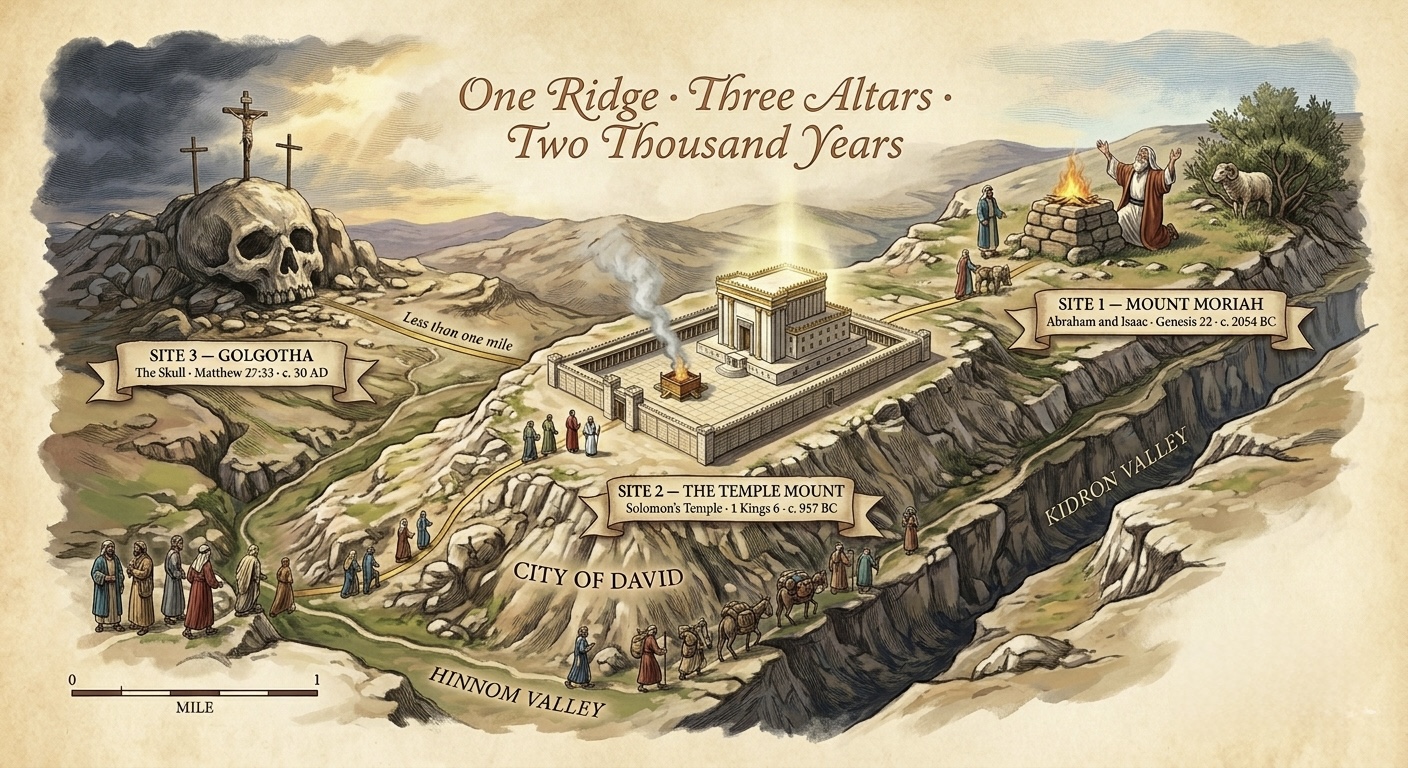
Isaac asked his question — "where is the lamb?" — on the way up a mountain. It floated unanswered for roughly 2,000 years. Then John the Baptist saw Jesus approaching the Jordan and said: "Behold the Lamb of God, who takes away the sin of the world." John 1:29 A son's question asked on the road to Moriah was finally answered by another Son walking toward his death. The question and the answer are separated by two millennia and connected by the same God.
This is what scripture calls a word of knowledge or word of faith — the Spirit enabling a person to declare what God is about to do before the evidence exists. Abraham did not invent this on Moriah. But he demonstrated it at its most extreme: a knife in one hand and a promise in his mouth, both at the same time, on the same mountain.
The gifts of the Spirit are not for comfortable moments. They are for the mountain. For the moment when every natural fact says one thing and the Spirit says another — and you have to choose which voice you trust.
Every year at Eid al-Adha — the Feast of Sacrifice — 2-3 million Muslims at Hajj and hundreds of millions worldwide sacrifice an animal in memory of this moment. Every family. Every year. Across every culture and continent where Islam exists.
Whether the son was Isaac or Ishmael — 4.2 billion people, more than half the human race, still circle around the question of what a man did on a mountain with his son and a knife and a God he trusted. No other story in human history has generated more worship, more prayer, more sacrifice, more pilgrimage. The covenant moment on Moriah is the most re-enacted act of surrender in history. And it is not finished yet. That question is still open to every one of them. The God who provided the ram still provides.
After the angel spoke, Abraham sacrificed the ram and named the place. God confirmed the promise again by oath — the strongest possible binding in the ancient world, God swearing by himself because there was no one greater to swear by. Heb 6:13 And then Abraham returned to his servants.
"Abraham returned to his servants." Gen 22:19 The Hebrew is singular. They traveled back to Beersheba. And from that verse forward, Isaac and Abraham are never recorded speaking to each other again in Genesis.
The next time Isaac appears, the text places him far to the south.
The place name carries the weight. Beer-lahai-roi means "Well of the Living One Who Sees Me" — the exact wilderness oasis where Hagar fled from Sarah years before. Gen 16:14 It lies far south of Beersheba, where Abraham was living. Isaac is dwelling at the well of the God who sees the abandoned — and it is there, lifting his eyes at evening, that he sees the camels of the servant Abraham sent to find him a wife. He meets Rebekah. He brings her into his mother's tent. He loves her. So Isaac was comforted after his mother's death. Gen 24:67
The response of faith. When her family hesitates and asks if she wants to wait, her answer is immediate and total: "I will go." Gen 24:58 She agrees to leave everything she knows — family, homeland, her whole past — to journey toward a groom she has never seen.
Her name fits her. Rivka comes from a root meaning to bind fast — to tie, to tether, to secure — and tradition hears in it the warmth of one who captivates and holds the heart. The bride who bound herself, sight unseen, to a man and to a promise.
Sarah died in the chapter between the mountain and the field. Genesis 23 opens with her age and her death in the same breath — no transition, no recovery time. Abraham came down from Moriah having just passed the greatest test in human history, with God's kingdom oath still ringing in his ears, and walked home to an empty tent. No fanfare. No celebration. Just grief and a burial to arrange.
Then comes a smaller detail, easy to read past. He had to negotiate with the Hittites for a piece of ground to bury her. Gen 23:3-4 A foreigner. No land of his own. Despite thirty years of God promising him this entire territory. The man God had just sworn to by his own name could not bury his wife without asking permission from people who owned what God had promised him. He wept. Then he got up and negotiated. Gen 23:2-3 Two verses. The whole weight of a life of faith in two verses.
Scripture never records Isaac coming down from Moriah. It does not say whether he was with Sarah when she died, does not say what he carried, does not name where he went. After the mountain the text simply goes quiet about him — as if the only honest response to what God asked that day was silence.
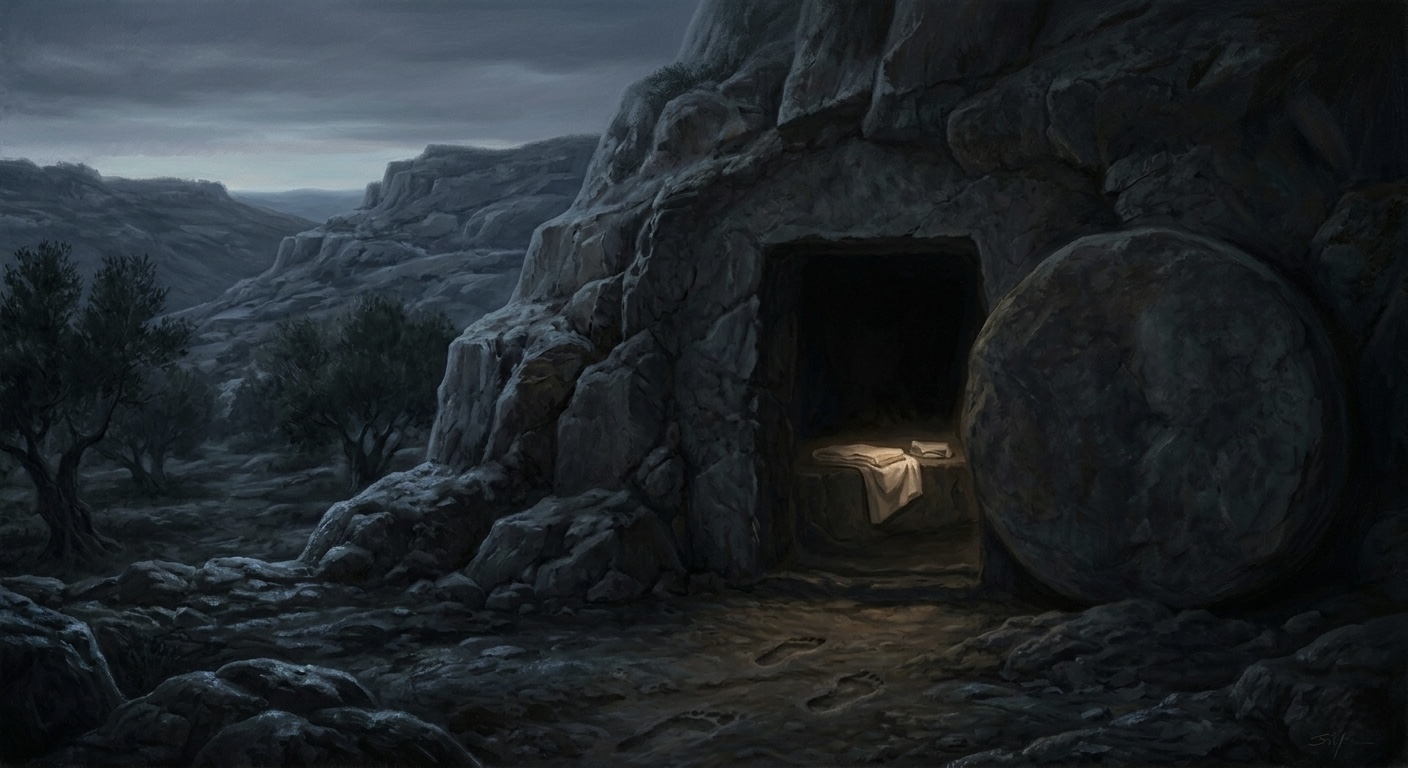
That silence sits over the rest of Genesis. It is not answered until another Father leads another Son up the same mountain range — and that Son, after the grave, keeps speaking. The silence on Moriah is broken forever at the empty tomb.
Whatever it cost them both — they gave it. And God kept every word of what he swore.
Genesis 24 opens with a single verdict on Abraham's entire life: "Abraham was old, well advanced in years, and the LORD had blessed Abraham in all things." Gen 24:1 Not a trial. A testimony. The narrator steps back after everything — the waiting, the failures, the Hagar detour, the knife on Moriah — and says: look at this man's life in total. Blessed in all things. That is what is on the other side of the mountain.
The address of your provision is the address of His presence — and His presence is always where He is establishing His kingdom.
Some obedience leaves a mark that never fully heals on this side. He still asks. And he still keeps every word.
This is the passage the Ethiopian eunuch was reading on his chariot when Philip ran to meet him. Acts 8:32-33 Written seven centuries before the cross. As a sheep before its shearers is silent, so he did not open his mouth. The same silence Isaac carried down Moriah — now on the Lamb who would not be spared. Isaac was bound and walked free; the ram took his place. Isaiah saw the picture finished: the Lamb who would take away not just one son's death sentence but the sin of the world.
For centuries a curtain sealed off the Holy of Holies — the one room where God's presence rested, entered by a single priest, one day a year, never without blood. Lev 16; Heb 9:7 When Jesus died, the curtain tore. Not from the bottom, where a man might reach. From the top down — Matt 27:51 — torn by the hand that first hung it. The God who stopped Abraham's knife did not stop his own. And the room no one could enter stood open. The barrier gone, the blood already brought. What Moriah pictured, the torn veil finished: the way to God thrown open, paid in full, to anyone who would walk in.
The prophecy the Ethiopian eunuch was reading had been sitting in a sealed clay jar in a desert cave for 2,000 years — and when it came out, it matched. Isaiah saw the crucifixion in 700 BC. The scroll that preserved his vision was hidden before Jesus was born and found after he rose. Israel Museum, Jerusalem. Shrine of the Book.
Hosea saw the same pattern from a different angle, writing 700 BC: "After two days he will revive us; on the third day he will restore us, that we may live in his presence." Hosea 6:2 Two prophets. Same vision. One mountain. One tomb.
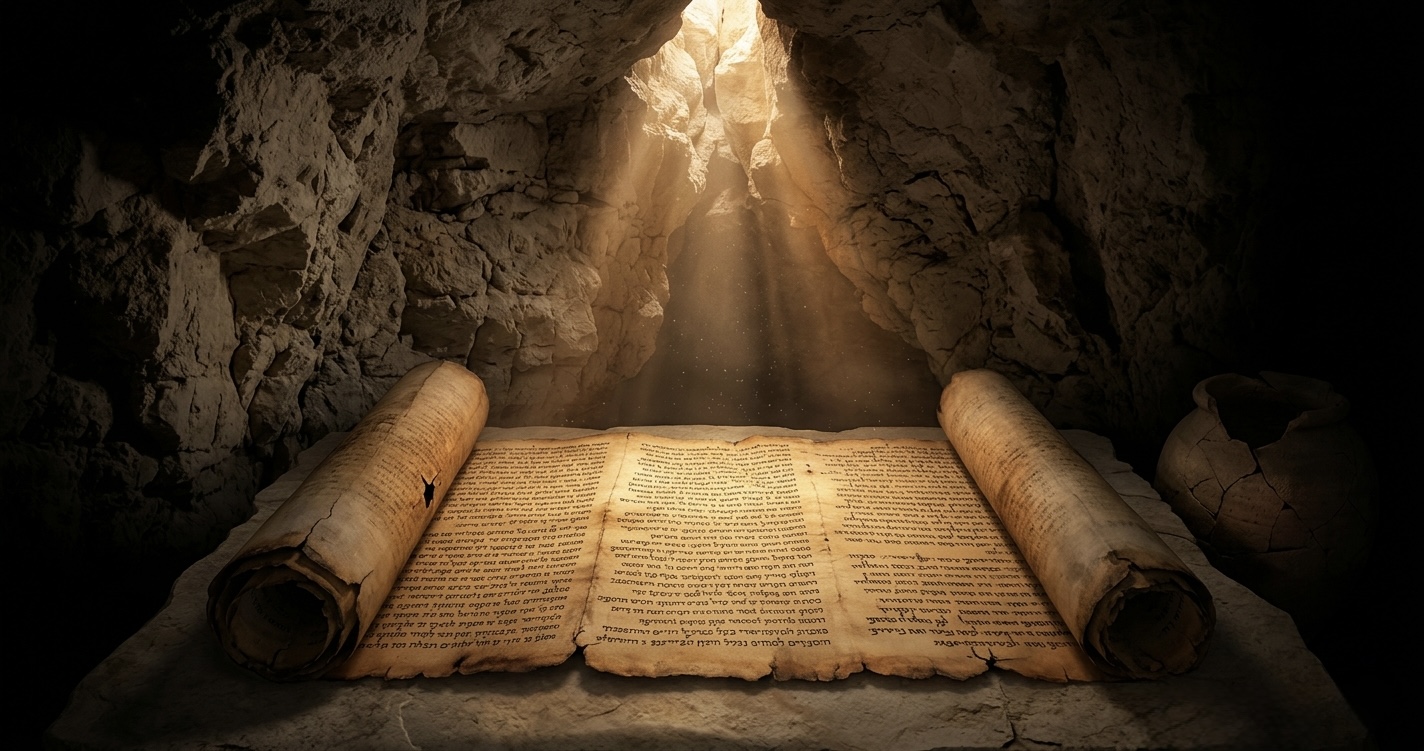
But Isaiah wasn't finished. Eight chapters later, he described what the Lamb would do after the suffering:
Seven hundred years later, Jesus stood in a synagogue in Nazareth and read this passage out loud. He rolled the scroll closed. Sat down. The room went quiet the way rooms go quiet when something irreversible has just been said. Then seven words: "Today this scripture is fulfilled in your hearing." Luke 4:21 Not someday. Not metaphorically. The man in front of them was the one Isaiah had seen. The Spirit he carried was about to be poured out on everyone who would receive him.
Every eye was on him.
Crown of beauty instead of ashes. Oil of joy instead of mourning. Garment of praise instead of despair. Not just a ticket out of judgment — a complete exchange. The old thing taken. The new thing given.
He didn't promise to improve the old life. He promised to trade it. Most people are still negotiating to keep the ashes.
The most important pre-Pentecost promise was not a prediction of a person. It was a promise about a transformation:
Not stone tablets — hearts. Not external law — internal transformation. Not learning about God — knowing him directly. The Hebrew word is yada — to know intimately, the way a husband knows a wife, the way a child knows a parent's voice in the dark. Not academic knowledge. Not doctrinal familiarity. Yada. The new covenant was not a revised ruleset. It was a promise of intimacy — God and his people in direct, personal, indwelling relationship. Hebrews 8 quotes this passage in full as the centerpiece of its argument about Christ. Heb 8:8-12
You were never meant to know about him secondhand. The whole promise was that you'd know him yourself.
The entire Bible is one story about God closing a distance. He walked with people in a garden, and that nearness was lost — and the ache you feel for something you can't name is the same ache the whole story is moving to heal. Every major movement in the covenant is God stepping closer.

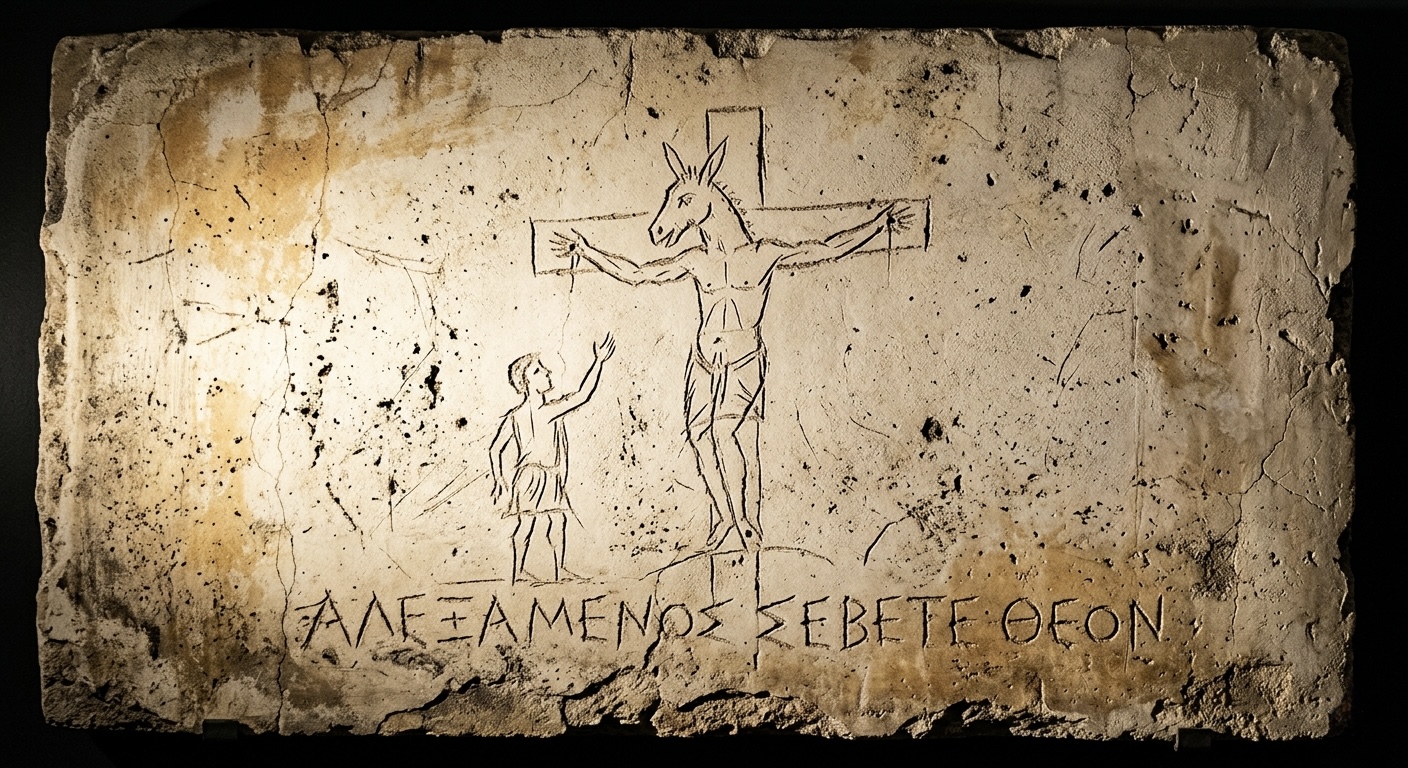
The Alexamenos Graffito. Scratched into plaster on the Palatine Hill in Rome, discovered in 1857, dated to the late 1st or early 2nd century AD — the earliest known image of the crucifixion. A Roman soldier is depicted worshipping a crucified figure with the head of a donkey. Below it, in crude Greek: "Alexamenos worships his God." It was mockery. A Roman drew it to ridicule a fellow soldier for believing in a crucified man. But in doing so, he confirmed — from inside the Roman military, within living memory of the event — that Christians were known to worship a figure who had been crucified. The derision is the evidence. The earliest picture of the cross was drawn by an enemy who couldn't stop thinking about it. Palatine Museum, Rome.
Phlegon of Tralles. A Greek historian, no Christian agenda, recorded c. 137 AD: "In the fourth year of the 202nd Olympiad [= 33 AD] there was the greatest eclipse of the sun — it became night at the sixth hour so that stars appeared. There was a great earthquake." Exact year. Exact hour. Earthquake. NASA confirms no solar eclipse was possible on Passover — full moon, wrong side of the earth. His attempt to explain it rationally is the most powerful secular confirmation it happened.
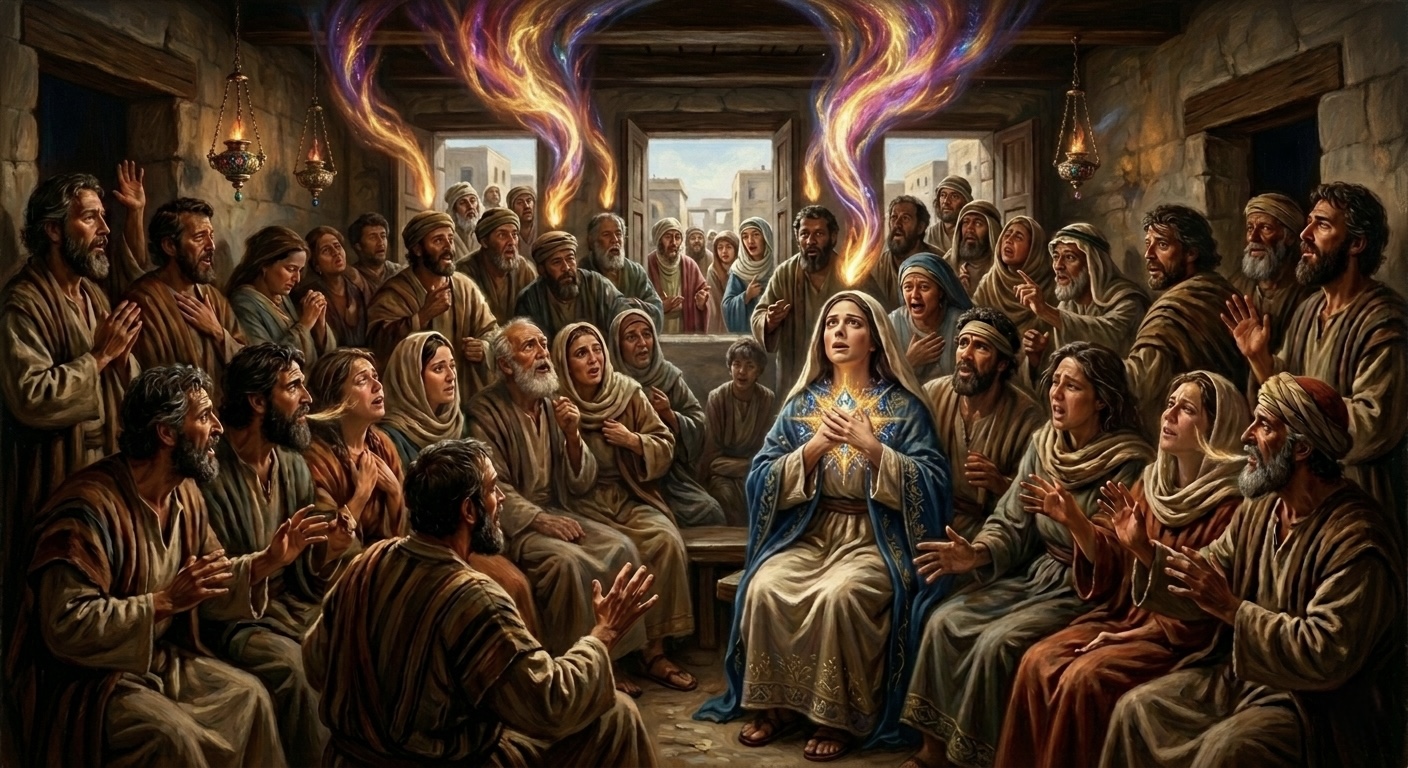
Pentecost — Shavuot in Hebrew — was one of three mandatory pilgrimage festivals. Deut 16:16 Every Jewish male was required to appear in Jerusalem. God used Israel's own calendar to ensure representatives from every nation were in the city on this day. He had commanded it for a thousand years. He planned the date. He filled the seats. Then the Spirit fell.
Shavuot also commemorated the giving of the Torah at Sinai — fifty days after the Passover that freed Israel from Egypt. Jesus died at Passover. The Spirit fell fifty days later, on the very festival that celebrated the old covenant's birth. Jeremiah's promise came true on its anniversary: the stone tablets of Sinai replaced by the living Spirit, written now on hearts. Jer 31:31-34
Every nation under heaven in Jerusalem heard in their own language. Present that day: Parthians, Medes, Elamites — modern Iran and Iraq. Egypt. Parts of Libya near Cyrene — North Africa. Visitors from Rome. Cretans and Arabs. Acts 2:9-11 Africa was represented at Pentecost. The fire did not fall only on Europe.
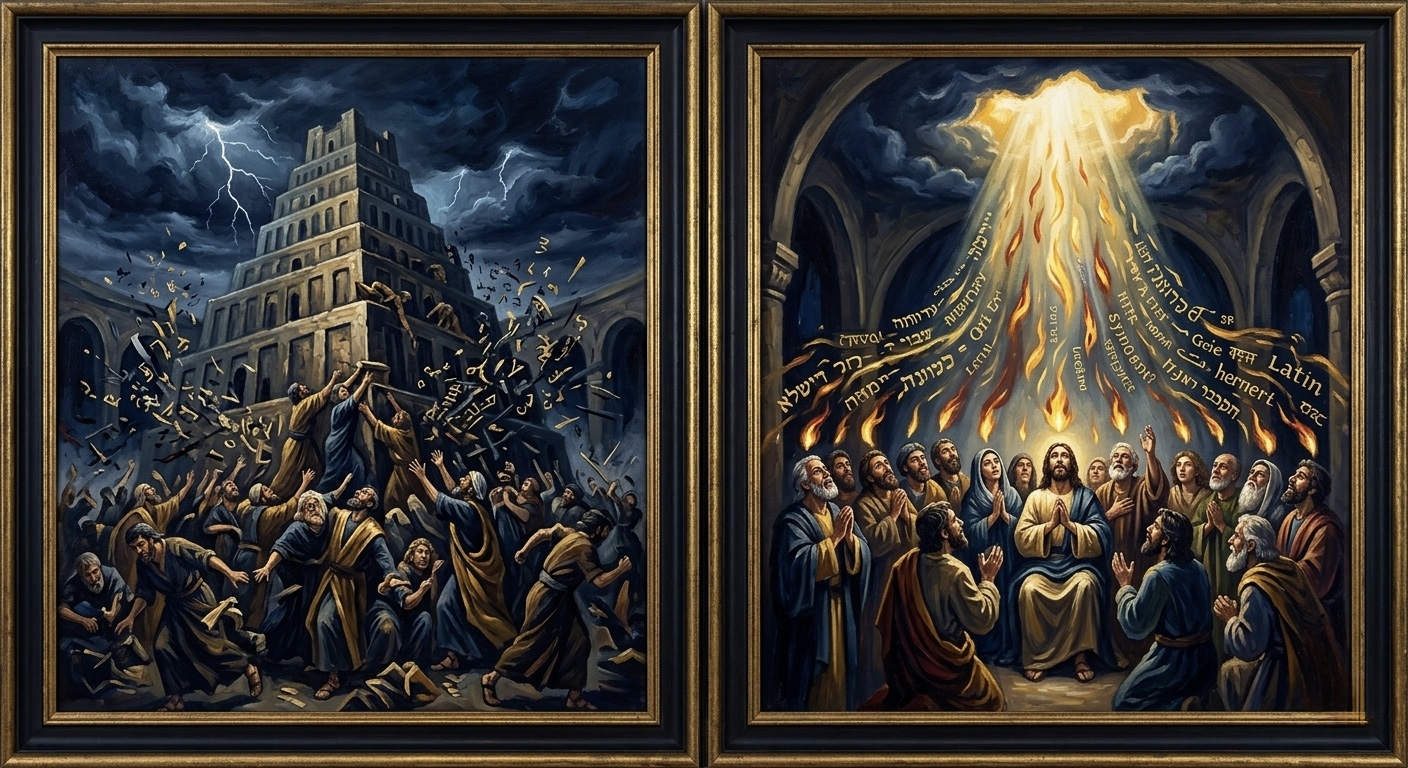
At Babel: One language divided into many. Humanity scattered. The project of unity collapsed under pride. God confused human speech so they could no longer understand each other. Gen 11:7-8
At Pentecost: Many languages gathered into one understanding. Humanity drawn back together. 120 people in one room, unified in prayer — and the Spirit fell and reversed the sentence of Babel in a single morning. Every divided tongue heard the same message. Acts 2:6
The Hebrew root of Babel is balal — to confuse, to muddle, to scatter. The Greek word at Pentecost for what the crowd heard is dialektos — their own dialect, their mother tongue. Not a common language imposed from above. Every person heard God speaking directly to them in the language of their childhood. Not the uniformity Babel tried to build. Something better: every voice distinct, every language honored, every nation included — and one message understood by all.
What pride scattered in Genesis 11, the Spirit gathered in Acts 2. Abraham's calling — that all peoples on earth would be blessed through him — fulfilled in tongues of fire, 2,000 years after it was promised.
The historian Luke — a physician, writing with documentary precision — records the nations present by name. This was not a vision or a metaphor. Representatives of the known world were in Jerusalem on a specific calendar date, heard in their own languages, and carried what they heard home. The reversal of Babel was a historical event with witnesses from every direction of the compass.
What pride scattered, the Spirit gathered. The thing that divided the human race was undone in a single afternoon.
Prophecy — Peter declared what God was doing in their generation, not his own analysis. Interpreting current events through the Spirit. Acts 2:14-36
Signs and wonders — the sound of violent wind, the visible fire, the immediate transformation of 3,000 people. Acts 2:43
This is the model. Not a one-time event to admire from a distance. A pattern to participate in. "The promise is for you and your children and for all who are far off — for all whom the Lord our God will call." Acts 2:39
Not just the Jews. Not just the church. Everyone who believes as Abraham believed — moving toward God on a word, trusting what cannot yet be seen — is a child of Abraham. The covenant has always been this open. Gal 3:29
Just before the church scattered from Jerusalem, Stephen stood before the Sanhedrin and gave the longest sermon in Acts. He retold the entire Abraham story — in precise detail — to the religious leaders who wanted to kill him. Acts 7:2-53 His central point: God's presence has never been tied to a location. He was with Abraham in Ur. With Joseph in Egypt. With Moses in Midian. The temple was never meant to contain him. The Spirit moves with his people — not the other way around.
They stoned Stephen. He became the first martyr. The persecution that followed scattered believers throughout Judea and Samaria. Acts 8:1 "Those who had been scattered preached the word wherever they went." Acts 8:4 The first mission cost the first martyr his life. The fracture became the sending. The same pattern as Hagar and Ishmael. The same pattern as Joseph in the pit. What the enemy intended as destruction, God used as distribution.
Every scattering in this book turned into a sending. The thing that broke your life apart may be the thing that carries it somewhere new.
Philip was in Samaria in the middle of a genuine revival. Not a manufactured one — signs and wonders, great joy in the city. Acts 8:8 People were being healed. Evil spirits were leaving. It was everything a minister works for. And in the middle of it, an angel appeared and gave him the strangest instruction in the book of Acts:
"Go south to the road — the desert road — that goes down from Jerusalem to Gaza." Acts 8:26
No name. No destination. No explanation. Just — the desert road. Leave the revival. Leave the crowds. Leave what is working. Go to the road that leads through empty land.
Philip went.
Then the Holy Spirit spoke again — a second divine intervention for the same assignment: "Go to that chariot and stay near it." Acts 8:29 Two separate directions from two persons of the Trinity. For one man. On one road. In the middle of nowhere.
This is the arithmetic of heaven: God pulled a revivalist out of a successful meeting to send him alone to a desert road for a single conversation with a single man. It does not run on crowds. It runs on the one. The Ethiopian official was worth the whole of Samaria in that moment — not because Samaria didn't matter, but because the Spirit was doing two things at once, and Philip was only needed for one of them.
The man in the chariot was the treasurer of the Kandake — the queen mother of the Kushite Empire — and he had traveled hundreds of miles to worship in Jerusalem. He was a God-fearer, a Gentile drawn to the God of Israel. And yet when he reached the temple, the law was clear: no one who has been emasculated shall enter the assembly of the LORD. Deut 23:1
He had crossed a desert and a lifetime to reach that gate. He stood at the threshold, close enough to hear the worship inside — and was turned away at the door.
So he bought a scroll of Isaiah and began reading on the way home. Specifically — he was reading Isaiah 53. The suffering servant. He was led like a lamb to the slaughter. He was despised and rejected. A man who had spent his whole life being excluded by religious law, reading a prophecy about someone else who was despised and rejected and led to slaughter — and asking, to no one in particular, who is this about?
Philip ran to the chariot. Literally ran — the Greek word is prosdramon, to run toward. Acts 8:30 He heard the man reading aloud — ancient reading was done aloud — and called out: "Do you understand what you are reading?"
The answer is one of the most honest sentences in scripture: "How can I, unless someone guides me?" Acts 8:31
He invited Philip in. Philip sat beside him. And beginning with Isaiah 53 — the passage about a lamb led to slaughter, about wounds that heal, about a man despised and rejected — Philip told him the good news about Jesus. Acts 8:35
The chariot rolled through the desert. Two men reading a scroll together. And Philip showed him the answer to the verse that had shut him out — Isaiah 56, where the same God who barred the eunuch in Deuteronomy overrules himself: "Let no eunuch say, 'I am only a dry tree.' For I will give them a name better than sons and daughters — an everlasting name that will endure forever." Isa 56:3-5 The law that excluded him and the promise that welcomed him, from the same God, resolved on a desert road in a single afternoon.
Then the chariot passed water. And the man who had traveled hundreds of miles to stand outside a temple door looked up and said:
Nothing. The law had said: you cannot enter. The temple had said: you do not qualify. The distance from Nubia to Jerusalem had said: this will cost you everything. And every one of those things had been wrong. Nothing stood in the way. Not his body. Not his nation. Not his excluded status. Not the thousands of miles of road between Ethiopia and the God he had traveled to find.
They went down into the water together. Philip baptized him. And when they came up out of the water, the Spirit of the Lord suddenly took Philip away — he was transported, the text implies supernaturally, to Azotus Acts 8:39-40 — and the eunuch never saw him again.
He went on his way rejoicing.
Alone. On a desert road. Carrying in his chest the news that would reach a nation. A man who had gone to Jerusalem looking for God and come home having found him in a chariot on a desert road, through a running stranger, through a seven-hundred-year-old prophecy about a lamb that had finally been fulfilled. He went home to the court of the Kandake of Ethiopia and the tradition of the Ethiopian church holds that he began preaching that day — in the palace, in the market, in the streets — and that the fire never went out.
The Spirit had interrupted a revival to light a different one. One person at a time. One desert road. One impossible conversation.
God pulled His best man out of a revival to find one stranger on an empty road. He has done that. For you. You just called it a coincidence.

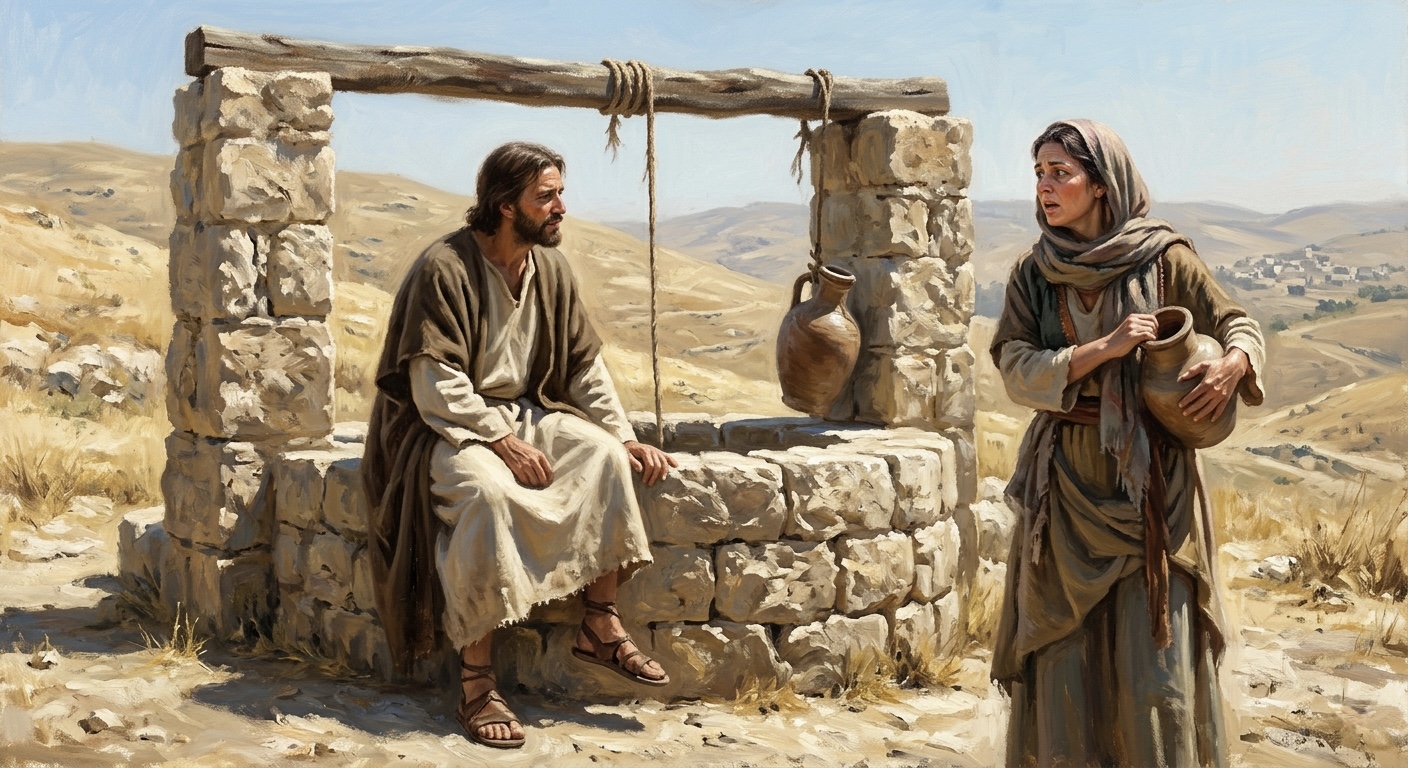
Before Philip ran to the chariot, before the Spirit fell at Pentecost — Jesus himself had already done what Philip would do on that desert road. He did it at a well. With a woman. In Samaria. At noon.
Jews did not travel through Samaria if they could help it. Samaritans were the half-breed remnant of the northern kingdom — intermarried with Assyrian settlers after the 722 BC conquest, holding a corrupted version of the Torah, worshipping on the wrong mountain. Centuries of contempt had calcified into law: a Jewish man did not speak to a Samaritan woman in public. Full stop.
Jesus sat down at Jacob's well and asked her for water. John 4:7
What followed was the longest recorded conversation Jesus had with any individual in all four gospels. He crossed every line — Jewish/Samaritan, male/female, righteous/outcast — and told her things he had not yet told his own disciples. She had five former husbands and the man she was with was not her husband. John 4:18 She came to the well at noon — not the cool of morning when women traveled together — because she came alone. She had been defined by her failures so long she had stopped expecting anyone to see past them.
Jesus named them all. And kept talking.
He told her that the water she was drawing would leave her thirsty again — but that he could give her water that would become "a spring of water welling up to eternal life." John 4:14 Then he told her something he had not said openly in Jerusalem, in the temple, to the Pharisees who demanded his credentials — he told her plainly: "I who speak to you am he." John 4:26 The Messiah. The woman at the well — excluded, Samaritan, carrying a history no respectable person would have touched — was the first person Jesus explicitly told who he was.
The early church historian Hippolytus of Rome (c. 170–235 AD) identified this woman by name — Photini, meaning "luminous one" or "the enlightened." According to the Eastern church tradition he drew from, she went on to evangelize in Carthage (North Africa) and eventually Nero's Rome — where she was martyred under the emperor. The Eastern Orthodox Church venerates her as Isapostolos: Equal to the Apostles. The woman who had been defined by her failures became one of the most traveled evangelists of the first century. Hippolytus of Rome, Commentary on Daniel, c. 204 AD.
Philip ran to a desert road for one excluded man. Jesus sat down at a well for one excluded woman. The Spirit does not calculate worthiness. He calculates thirst.
The eunuch's encounter was not Ethiopia's first contact with the covenant. A thousand years before Philip ran to that chariot, the Queen of Sheba traveled to Jerusalem to test Solomon's wisdom. 1 Kings 10:1-13 After hearing his answers she said: "The half was not told me." Jesus cited her himself: "The Queen of the South will rise at the judgment with this generation and condemn it — she came from the ends of the earth to listen to Solomon's wisdom, and now something greater than Solomon is here." Matt 12:42 Jesus put her in his own teaching as a model of seeking wisdom at any cost.
Ethiopia's national epic — the Kebra Nagast — records that she returned carrying Solomon's son Menelik I, who later brought the Ark of the Covenant to Axum. The Ethiopian Orthodox Church claims to hold it today in the Chapel of the Tablet. Whether historically verifiable or not — Ethiopia sees itself not as a late addition to the covenant story but as a covenant-carrying nation from Solomon's time forward. The eunuch was a reconnection.
Psalm 68:31 — "Ethiopia will stretch out her hands to God" — has been cited by Ethiopian Christians for 1,700 years as their national prophetic calling. Written by David. Fulfilled by Philip on a desert road.
Pliny the Younger — Roman governor, writing to Emperor Trajan c. 112 AD — reported a legal crisis: Christians in his province had grown so numerous they were collapsing the market for sacrificial animals. Temples were going empty. He couldn't figure out how to prosecute them all. The expansion of the church was a Roman economic and administrative crisis within 80 years of the resurrection. Pliny, Letters 10.96, c. 112 AD.


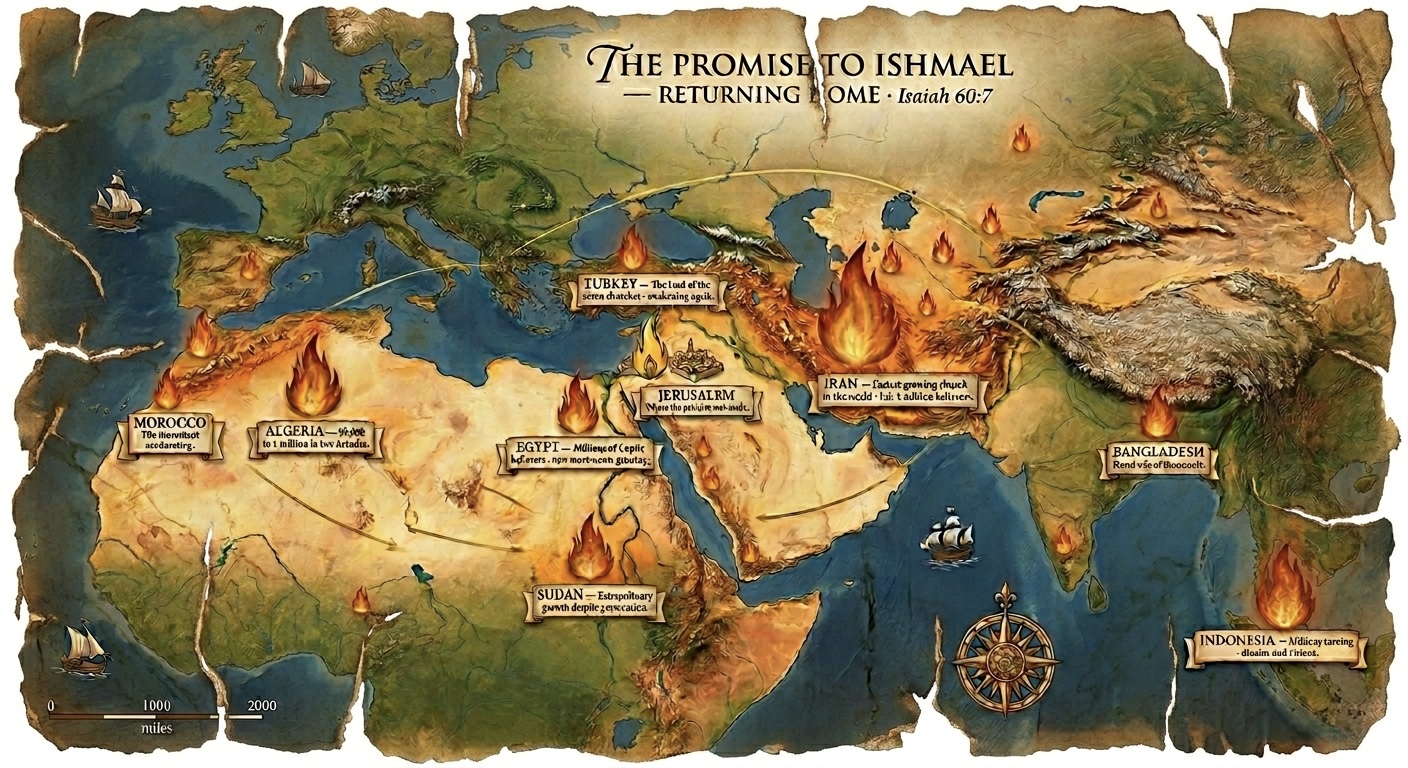
After Damascus, Paul withdrew to Arabia before returning — three years before his first Jerusalem visit. Gal 1:17 The apostle chosen to reach the Gentiles went first to Ishmael's territory. The Spirit was choreographing the same movement he had sent Philip on — covenant messengers to Ishmael's descendants first.
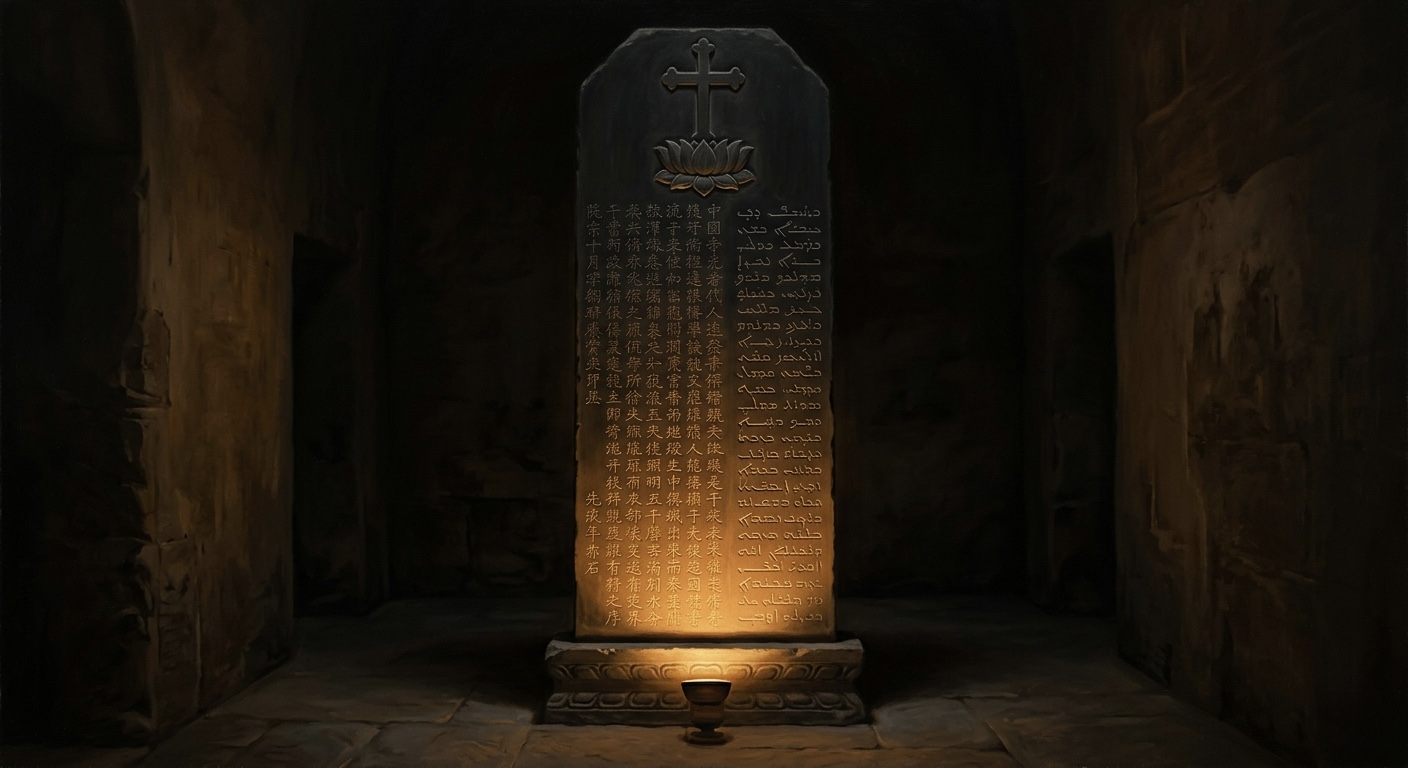
Acts 10 — a Roman centurion named Cornelius. Devout, God-fearing, generous to the poor, praying regularly. Acts 10:2 An angel appeared: "Your prayers and gifts to the poor have come up as a memorial offering before God." Acts 10:4 God gave Peter a vision simultaneously — a sheet with unclean animals: "Do not call anything impure that God has made clean." Acts 10:15
Peter arrived and began preaching. Then — before he finished — "the Holy Spirit came on all who heard the message." Acts 10:44 The Jewish believers with Peter were astonished. "Can anyone keep these people from being baptized? They have received the Holy Spirit just as we have." Acts 10:47 The Spirit moved before the theology caught up. The Spirit goes first. Human understanding follows. Human institutions resist. Then — if willing — they catch up to what God has already done.
God didn't wait for the room to approve him. He rarely does. He is usually already moving in the place you were taught he couldn't go.
Acts 15 — the first existential crisis of the church. Jewish Christians demanded Gentiles be circumcised before they could be saved. Acts 15:1 If they ruled yes — Christianity becomes a sect of Judaism. The promise to all nations closes to anyone who does not first become Jewish.
Peter stood on what had happened at Cornelius' house: "God made no distinction between us and them, purifying their hearts by faith. Why test God by putting on the Gentiles a yoke neither we nor our ancestors could bear?" Acts 15:9-10 James quoted Amos 9:11-12: "so that the rest of mankind may seek the Lord, even all the Gentiles who bear my name." An Old Testament prophecy tracing back to the Abrahamic promise was the deciding argument. The promise to Abraham was always this big. The Jerusalem Council was not a new decision. It was the recognition that Genesis 12:3 meant exactly what it said. If they had voted the other way, you would not be in this story.
The empire that crucified Jesus became the empire that could not contain his followers. The harder Rome pushed, the further the gospel went. The same Spirit who gave Philip a word of knowledge on a desert road was equipping ordinary people across the empire to do exactly what Jesus had promised.
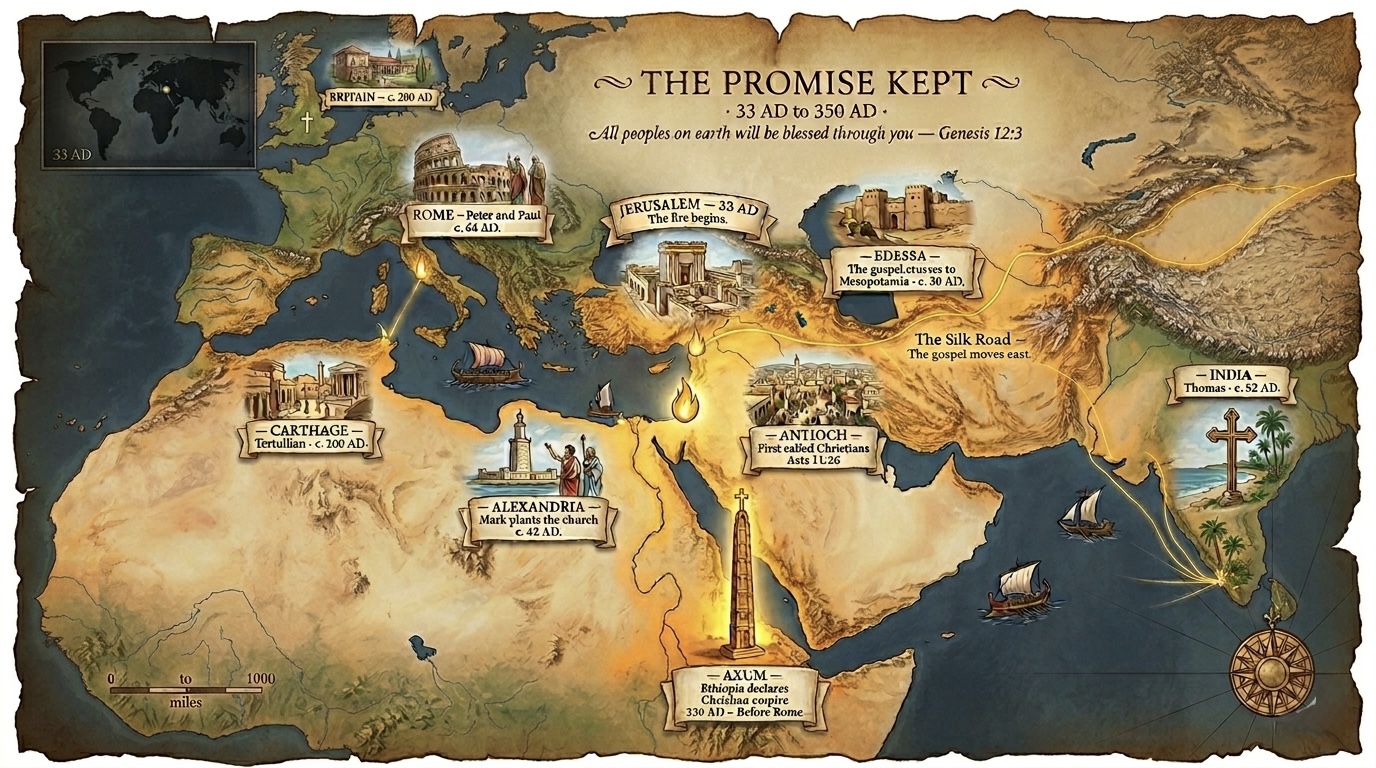
One discovery drove people toward a faith that cost them everything: the God they had been told was impersonal — distant, cosmic, unreachable — turned out to be personal. He knew their name. He saw their pain. He came close. He healed. He called her daughter. He ran to meet the prodigal son. He heard the crying of a boy under a bush in the desert. That God. That is what changed the world.
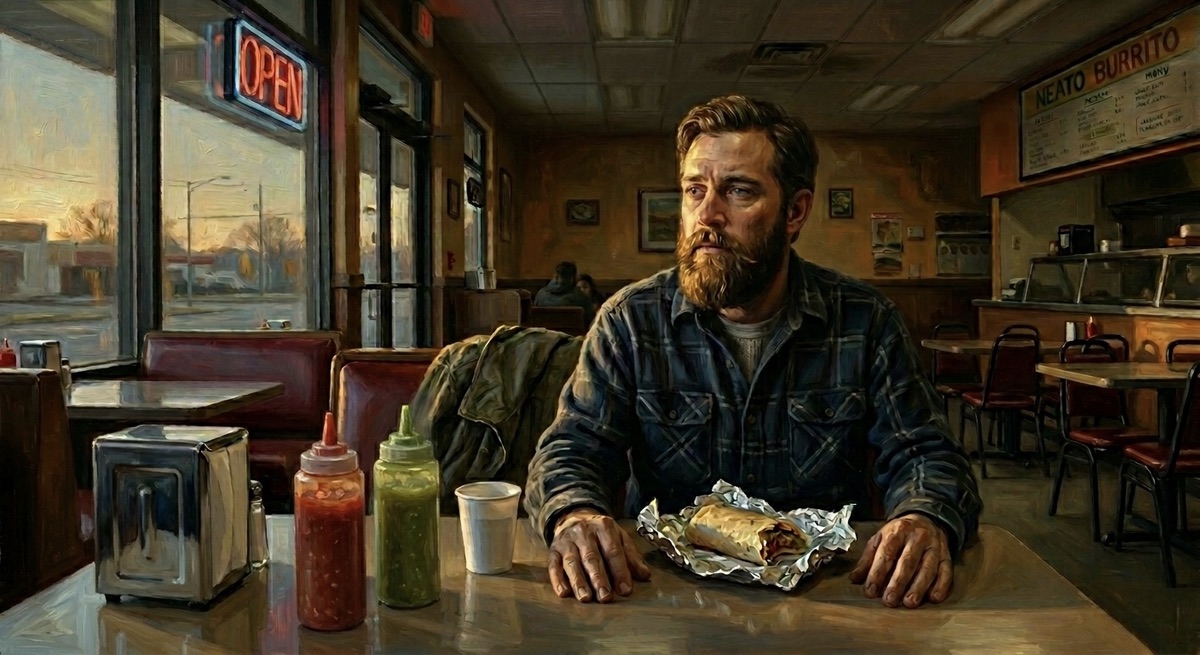
He didn't. He put his burrito down.
His name was Ken. He told us about a recent stroke, high blood pressure, and migraines that had been crippling him every single day since he was six years old. I felt prompted to ask if he had lost a sibling. He said no.
Then he told us about Lilly.
His daughter. Born with a condition so rare she was only the 18th documented case in the world. She lived a few hours. Her birthday had just passed — she would have been seven. His last pastor had stood at that bedside with him. After that day, Ken stopped going. He just couldn't.
Then something happened in the conversation. He went quiet for a moment. And he said — his brother. Born the same day as Ken. Didn't make it. Two children. Gone before he could know them. He had been carrying both his whole life without realizing the weight had two names.
We prayed. We prophesied. We spoke life over a man who had been running on empty for years. I gave him my number.
He called the next day.
He had a dream about Lilly — but she wasn't a baby. She was the age she would have been that day. She looked strikingly like her mother. And she was with Jesus.
Then he told me the other thing.
No migraine. For the first time since he was six years old.
He never walked back into a church. Not since Lilly. He sat down at Neato Burrito with a burrito he never finished. And he sat down with the One who sees him.
The Lord wants to remind you — he is there. If you listen closely, you might hear him in a still small voice, in a burning bush, or in the God-coincidence you almost explained away.
What happened to Ken has a name. It is the same God Hagar met at the spring — El Roi, the God who sees. Ken sat down with a burrito and was seen. Matthew uses the word when Jesus heals the woman who had bled for twelve years — excluded by law, untouchable, who fought through a crowd just to touch the hem of his robe. Jesus stopped. Turned. And called her daughter.
The word translated well is sozo. Strong's defines it: to save, deliver, protect — to heal, preserve, make whole. Spirit, soul, and body. He didn't just stop her bleeding. He gave her back her name, her dignity, her place in the family. He didn't call her patient. He called her daughter. Ken didn't get a symptom removed — he got made whole. That is sozo. Not a doctrine received — a life put back together. Not just heaven secured — heaven brought near.
Ken sat down to eat a burrito. He stood up having met the One who sees him — no church, no altar, no pastor. So what are you still waiting for a building to hand you?
That is still happening. In a burrito shop in our city. In a chariot on a desert road. In a dream in Tehran at three in the morning. The works have not stopped. The Spirit has not retired. "The one who believes in me will do the works I have been doing — and greater works than these." John 14:12
It was the last thing he asked for before he died. It is the one thing we have been worst at giving him.
2. The movement becomes an institution.
3. The institution hardens around truth — tradition replaces encounter.
4. The Spirit drains. The form remains. The power diminishes.
5. Reformers arise — usually Spirit-led, often charismatic.
6. The institution resists and persecutes.
7. A split. The new movement becomes an institution. Return to step 2.
The only force that has ever broken this cycle is the Holy Spirit — poured out on people willing to stay together in one accord and wait. Acts 1:14
William Seymour was forced by Jim Crow law to sit outside the classroom in Houston — learning the things of God through a crack in a door, because he wasn't allowed inside. The man God would use to launch a movement of 600 million was made to listen from the hallway. He went to Los Angeles anyway. What broke loose at Azusa Street is in the timeline below — but here is the thing worth stopping on: the fire fell on the man they shut out, and when it fell, it washed the color line away in a city that had drawn it everywhere.

Every split in church history started with people who were sure they were right. The Spirit never fell on the ones who were right. He fell on the ones who stayed in the room.
From that prayer meeting came the first sustained Protestant missionary movement. The Moravians sent more missionaries per capita than any other church in history — to Greenland, the Caribbean, Africa, North America. They reached enslaved Black populations in the Caribbean when no other church would. John Wesley met Moravians crossing the Atlantic and his heart was "strangely warmed" — giving birth to Methodism and the first Great Awakening. Modern global missions was born in a prayer meeting among people who had just stopped fighting. — August Spangenberg, Life of Nicholas von Zinzendorf, 1838.
In 1906 Jim Crow America — Black, white, Hispanic, and Asian believers worshipped together, wept together, received the Spirit together. Eyewitness Frank Bartleman wrote: "The color line was washed away in the blood." From Azusa Street the entire global Pentecostal movement was born — 500-600 million believers worldwide today. The Spirit did in one building in Los Angeles what Jesus had prayed for in the upper room. — Frank Bartleman, Azusa Street, 1925.
God said to Abraham: "As for Ishmael, I have heard you. I will surely bless him." Gen 17:20 Between the 8th and 13th centuries the Islamic world produced one of the greatest civilizations in history — the Islamic Golden Age. Arab scholars preserved Greek philosophy, pioneered algebra and algorithms, advanced medicine and navigation while Europe was in its Dark Ages. The numerical system used globally today is Arabic. The word algebra comes from Arabic al-jabr. The blessing of fruitfulness and greatness God promised Ishmael — historically, visibly, documentably kept.
Muhammad was born around 570 AD in Mecca — into the Quraysh tribe, guardians of the Kaaba, which by his time had been filled with 360 idols. The original monotheistic shrine Abraham and Ishmael had built had become a polytheistic temple. Arabia had already heard the gospel — it was represented at Pentecost Acts 2:11 and Paul spent three years there after his conversion. Gal 1:17 Islam arose 600 years after the gospel had already been present in Ishmael's territory. The question of what happened in those 600 years — why the church failed to keep its presence among Abraham's other children — is one of the most sobering questions in church history.
| Pillar | Practice | Abrahamic Root |
|---|---|---|
| Shahada | Declaration of faith in one God | Abraham's declaration of monotheism — burning the idols, reasoning toward the Creator |
| Salat | Prayer five times daily facing Mecca | Abraham's posture of continual seeking and intercession before God |
| Zakat | Giving to the poor — 2.5% of wealth | Abraham's generosity — hospitality to strangers, tithe to Melchizedek |
| Sawm | Fasting during Ramadan | Spiritual discipline — drawing near to God as Abraham drew near |
| Hajj | Annual pilgrimage to Mecca | Re-enacts Hagar running between Safa and Marwa, the Zamzam well God provided, Abraham's willingness to sacrifice his son. 2-3 million people performing the covenant narrative with their bodies annually. The Zamzam well still flows. |
Islam honors a transcendent God — vast, sovereign, holy beyond comprehension. This is true and right as far as it goes. But the tabernacle progression shows God was never satisfied with distance. He kept moving closer. At each step saying: I want to be nearer than this.
The New Testament word for God is Abba — the Aramaic word a small child uses for their father. Not the formal av. Not a title. The word a child uses when they run in from outside and need something. Intimate. Immediate. Unafraid. Jesus taught his disciples to begin prayer this way Matt 6:9 — not with distance, not with formality, but with the most intimate word a child of the ancient world could use. Paul writes: "The Spirit you received does not make you slaves, so that you live in fear again; rather, the Spirit brought about your adoption to sonship. And by him we cry, 'Abba, Father.'" Rom 8:15
The covenant with Abraham promised not just greatness and numbers but relationship — "I will be their God and they will be my people." Jer 31:33 The indwelling Spirit — God living inside the believer, praying through the believer, speaking to the believer personally — is what the tabernacle progression was always moving toward. It is the nearness every child of Abraham was made for. And it is exactly what God is now offering the half of the family that has known him as far and high and holy: not a smaller God, but a nearer one — the Spirit of El Roi, the God who sees, the name Hagar gave him at a desert spring. The same God. Closer than they were told he could come.

This is not history. This is happening tonight.
Imagine you are a man in Tehran. You have never held a Bible. You have never spoken to a Christian. The government of your country makes it a crime to leave Islam. Your friends, your family, your job, your safety — everything depends on you staying exactly where you are.
And then you have a dream.
A man in white appears. He says your name. He says: I love you. He says: follow me. You wake up trembling. You do not know who he was. But you cannot stop thinking about it. You have the dream again. And again.
You start asking questions you are not supposed to ask.
He crossed a closed border, a death sentence, and 1,400 years of history to say one name in a dream. No door you've locked is harder to reach than that one.
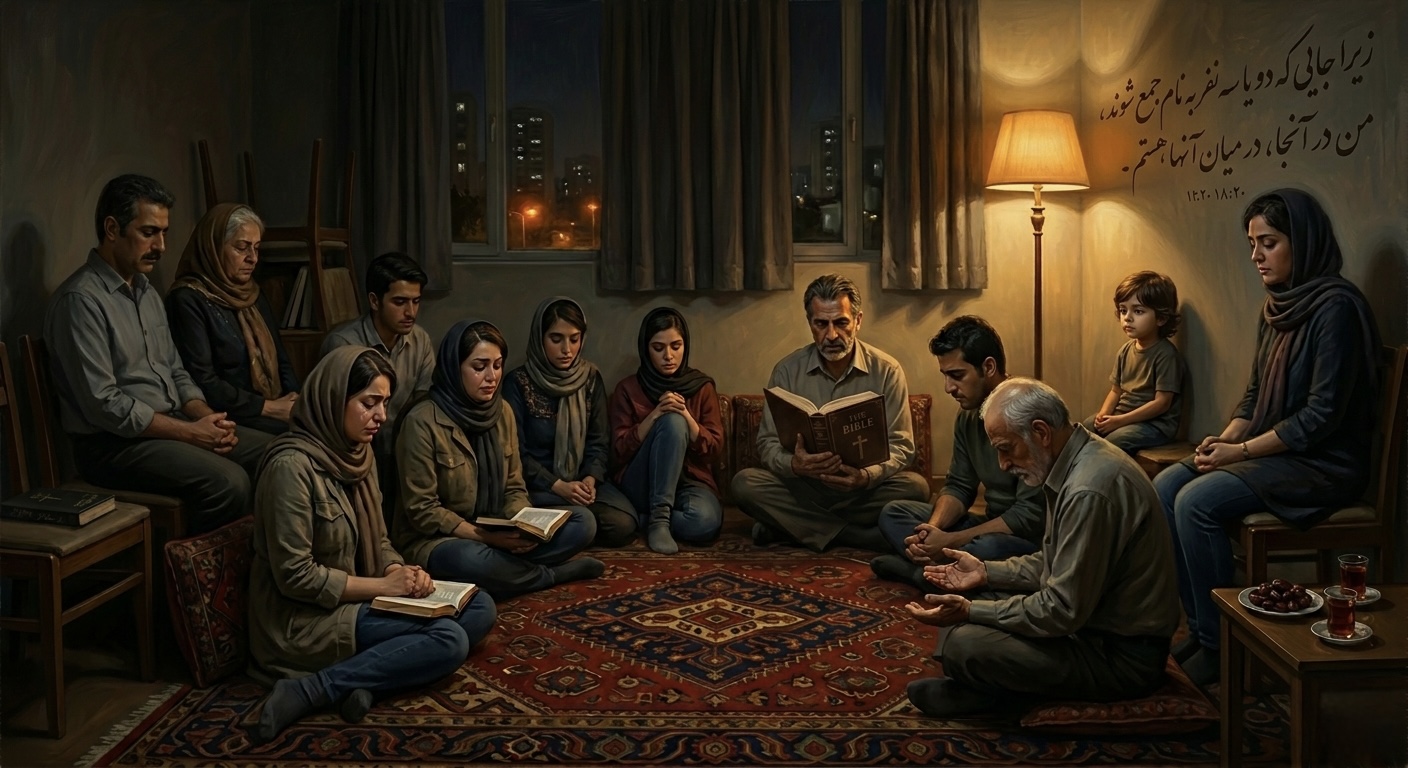
This is happening to thousands of Iranians every year. Not hundreds. Thousands. David Garrison — former Global Research Leader for the International Mission Board — conducted the most comprehensive academic study of Muslim conversions ever undertaken, documented in A Wind in the House of Islam (2014, WIGTake Resources). He interviewed over 1,000 former Muslims across 30 countries and found 69 separate movements of Muslims turning to Jesus since 1980. His conclusion: more Muslims have come to Christ in the last 40 years than in the previous 1,400 combined.
The primary factor reported by converts across every culture and country: dreams and visions of Jesus. Acts 2:17 — "your young men will see visions, your old men will dream dreams." The Spirit moving through the prophetic gift to reach people no missionary has been able to reach. Iran. Iraq. Algeria. Sudan. Indonesia. Bangladesh. Morocco.
Iran specifically: Open Doors, Elam Ministries, and Operation World independently estimate the Iranian church grew from essentially zero in 1979 to hundreds of thousands — some estimates exceeding 3 million believers. Under the most restrictive Islamic government on earth.
The wall that Babel built, that empires reinforced, that centuries of hostility hardened into stone — the Spirit is walking through it in dreams.
Isaiah 60:7 — "All Kedar's flocks will be gathered to you." Kedar was Ishmael's son. Gen 25:13 A prophecy that Ishmael's specific descendants would be gathered to God. Derek Prince — who lived in Jerusalem for years and taught extensively on the Arab-Israeli conflict — identified Genesis 16:12 not as a curse on Ishmael but as a consequence of expulsion — a wound that would be healed when the covenant love that should have been extended to him was finally extended through the gospel. The hostility is not a sentence. It is a season.
The same Spirit that showed Hagar a well when she thought her son was dying is opening eyes to living water across the Islamic world.
God heard the boy crying in the desert 4,000 years ago. He has not stopped hearing.
The largest turning of Muslims to Christ in history is happening right now. It is the most documented, least reported story in modern Christianity. And it is the Spirit of God keeping his promise to Abraham — that all peoples would be blessed through him.
Paul's image: Israel is the cultivated olive tree. The Gentile church is wild branches grafted in. The root supports the branches — not the other way around. Rom 11:18 The modern return of Jewish people to the land Abraham was promised — Israel reestablished 1948, Jerusalem reunified 1967, Ethiopian Jews airlifted home 1984 and 1991 — is cited by charismatic scholars including Derek Prince, David Pawson, and Lance Lambert as the most visible fulfillment of Ezekiel 37 in modern history. The valley of dry bones gathering. The covenant still active on both tracks simultaneously. The story is not finished.
Egypt — Africa. Assyria — modern Iraq, Syria, Iran — the heart of the Arab Muslim world. Israel — the Jewish covenant line. All three called God's people. In the same verse. By the same God. Abraham's prayer — "If only Ishmael might live under your blessing" — will be fully answered. Just not yet. And the church — Spirit-filled, unified, carrying the same power that fell at Pentecost — is supposed to be part of how it happens.
Early in this story — before the covenant ceremony, before Isaac, before Moriah — Abraham returned from battle and was met on a road by a king with no genealogy. No father named. No mother named. No beginning and no end in the text. He came with bread and wine and blessed Abraham in the name of God Most High, Creator of heaven and earth. Gen 14:18-20 Abraham gave him a tenth of everything.
His name was Melchizedek. King of Salem — which would become Jerusalem. Priest of God Most High — a priesthood that preceded Israel, preceded the Levites, preceded every religious system that would come after. A priest-king serving every nation before any nation was chosen.
The priesthood of Aaron — the Levitical system, the temple, the sacrifices — was always temporary. It required constant repetition. The priest who served it died and was replaced. The sacrifice had to be offered again and again. It was never designed to be the final answer. It was designed to point to one.
The priesthood of Melchizedek is different. It precedes Israel. It has no genealogical qualification. It requires no bloodline, no tribe, no nation. It is universal — the way God's covenant with Abraham was always universal, the way the blessing was always for every people. Psalm 110:4 — written by David a thousand years after Genesis 14: "The LORD has sworn and will not change his mind: you are a priest forever, in the order of Melchizedek." A Messianic prophecy. A priest-king who would serve forever, in the order that preceded every nation.
Hebrews identifies Jesus as that priest. Not in Aaron's line — in Melchizedek's. Heb 7:17 Which means the priesthood that began before Israel exists will also outlast every national and religious boundary when the story ends. The bread and wine Melchizedek served Abraham on a road in Canaan are the same bread and wine the church takes today from every nation, tribe, and tongue. The circle closes where it began — not at a temple, not on a mountain, but on a road, with bread and wine, before a priest-king who belongs to every people.
The promise made before circumcision. The priesthood that preceded the law. The blessing offered to all nations before Israel existed. This was always how it was going to end.
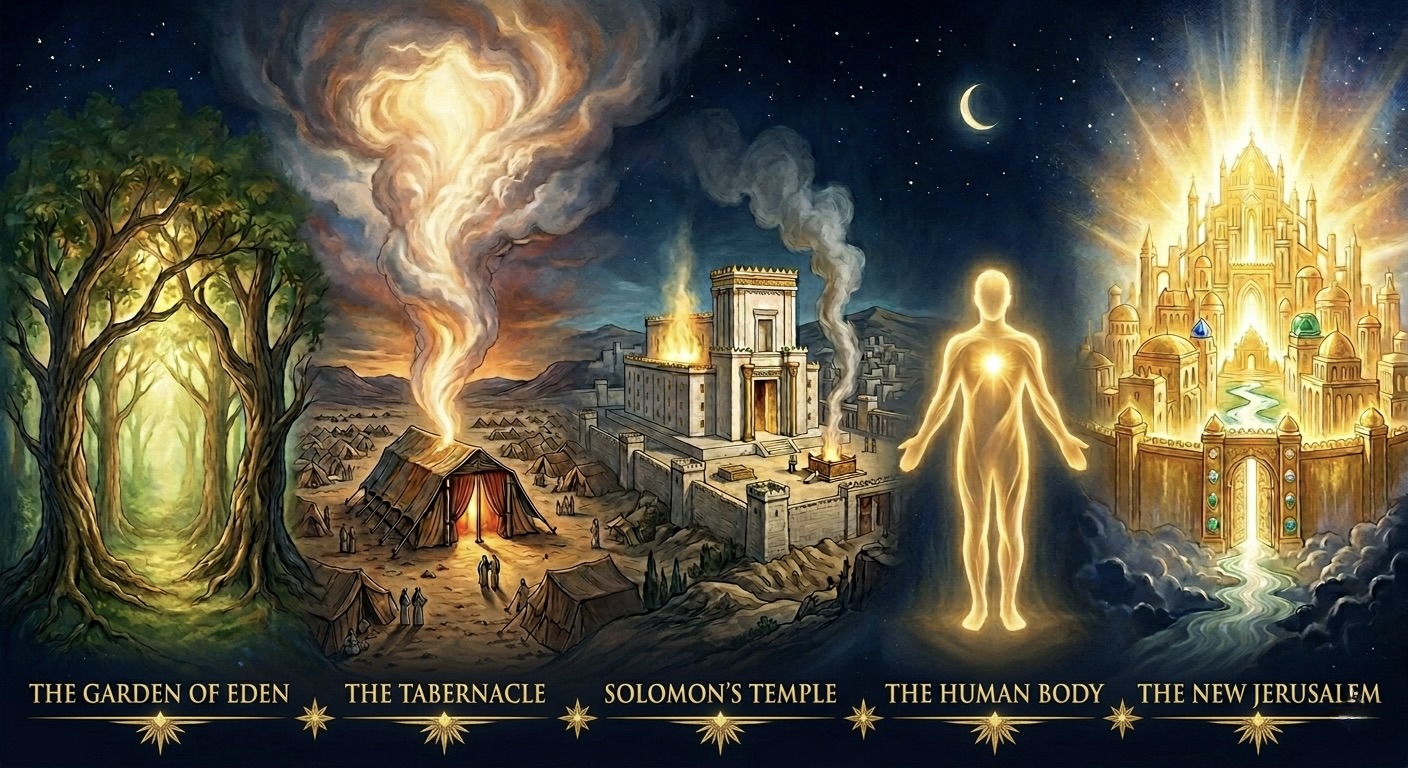
Abraham looked up at stars he couldn't count. God said: that is how many. John looked at a crowd he couldn't count. God said: those are them.
Every nation. Every tongue. Ishmael's children there. Isaac's children there. The eunuch's descendants. The Moravian missionaries. The Iranian house church believers who met in secret. The Azusa Street worshippers who crossed the color line in 1906. The Ethiopian Orthodox who have carried the covenant since Solomon. The Muslim convert who saw Jesus in a dream last night in Tehran.
One promise. One Spirit. Every nation.
And the writer of Hebrews makes one final statement that changes everything about how you read your own life:
Abraham didn't see the fulfillment. Isaac didn't. The Ethiopian eunuch didn't. They saw it from a distance and welcomed it. Heb 11:13 The Hall of Fame is not closed.
You are one of those stars Abraham couldn't count. You were in this promise before you were born.
The same Spirit who hovered over the waters in Genesis 1, who spoke to Abraham in Ur, who fell at Pentecost, who sent Philip running to a chariot, who is appearing in dreams in Iran tonight — is available to you. Right now. In this moment.
This is the story you just read.
From freedom to promise.
A smoking firepot in Canaan.
A ram caught in the thicket.
A eunuch going home rejoicing.
A woman named at a desert spring.
A dream in Tehran at three in the morning.
One Spirit. Every nation.
The story isn't finished.
So that Jesus' love will be reflected —
And this love will give birth
To many people being resurrected,
Redirected and completely accepted
To a wonderful and glorious rebirth.
You made a promise before I existed.
You signed it alone so I could never break it.
I come to you the way Abraham did —
not with perfect understanding,
not knowing where this goes,
but moving toward your voice.
Fill me with the same Spirit
that fell at Pentecost,
that sent Philip to a desert road,
that is falling in Iran tonight.
Make me part of what you are building.
I am in this story.
And the story isn't finished.